

Home
Studies
& Data Analysis
Methods
Microscope studies
Flagella experiment
Laboratory math
Blood fractionation
Gel electrophoresis
Protein gel analysis
Mitochondria
Concepts/ theory
Keeping a lab notebook
Writing research papers
Dimensions & units
Using figures (graphs)
Examples of graphs
Experimental error
Representing error
Applying statistics
Principles of microscopy
Solutions & dilutions
Protein assays
Spectrophotometry
Fractionation & centrifugation
Radioisotopes and detection
Guide to the study
Lab part 1
- tutorial/specimens
- Paramecium
- Chlamydomonas
- fixing/observingflagella
- Chaos (Pelomyxa) carolinensis
- Naegleria gruberi
- the five kingdoms
Lab part 2
- experiment introduction
- microtubules
- amputating flagella
- experimental design
- data collection
- class data
Cellular 'Slime Molds:' Dictyostelium and relatives
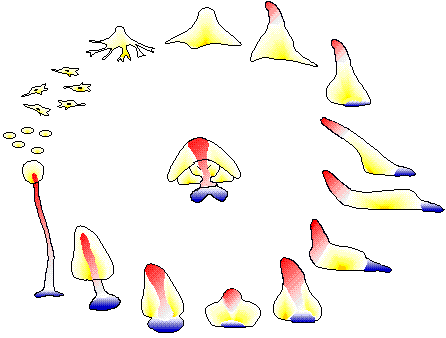
An important philosophy of experimental biology holds that radically different organisms solve similar problems in similar ways. While a primary goal of a scientist may be to discover what is wrong with the cell recognition systems of human cancer cells, the genetic mechanisms behind the problem may be too complex to unravel. While the human genome is large and highly complex, that of the cellular slime mold Dictyostelium discoideum, which is presently under study in a great many laboratories in cell biology, is about 100 times smaller than the human genome. Dictyostelium is easy to propagate, and the complete life cycle can be induced in the laboratory. It is a practical matter then, to determine the entire gene sequence for Dictyostelium, and to learn the basics of many cellular processes through genetic engineering and experimentation.
The cellular slime molds were formerly considered to be 'lower fungi.' Although they superficially resemble fungi in some respects, they are included in the Kingdom Protista. Individual cells resemble small amoebae and move and feed in an amoeboid manner, thus they are called 'myxamoebae' (to distinguish them from true amoebae). Dictyostelium was first discovered in 1935 in a forest in North Carolina and has since been found, along with similar genera, in many such environments around the world. The myxamoebae feed on bacteria in decaying vegatation, and reproduce by binary fission as do all amoeba.
Cellular slime molds would be just another minor note in the keys to the invertebrates except for a unique series of developmental events that occurs when they are deprived of bacteria. The cells begin to associate, forming streams of migrating cells which merge in an aggregate consisting of up to 100,000 cells. The multicellular aggregate secretes material that forms a sheath around the entire structure, which forms a tower of cells. In the absence of light the tower topples and migrates as a single organism, called a pseudoplasmodium, slug, or grex. The slug resembles a blob of petroleum jelly, leaving a trail of slime as it migrates.
Following migration (or immediately upon aggregating if there is plenty of light), the slug contracts and the anterior tip begins to rise to form a fruiting body. As the fruiting body forms, the cells differentiate into a base, stalk, and apical mass containing encapsulated spores. The spores can tolerate a wider range of environmental conditions than myxamoebae, and germinate following dispersal, renewing the cycle.
Studies of Dictyostelium can be directed toward cell-cell recognition, cell motility and adhesion, mechanisms for cell determination and differentiation, and related processes, making it a valuable model for cell biologists.

Visitors: to ensure that your message is not mistaken for SPAM, please include the acronym "Bios211" in the subject line of e-mail communications
Created by David R. Caprette (caprette@rice.edu), Rice University 27 Jun 96