

Home
Studies
& Data Analysis
Methods
Microscope studies
Flagella experiment
Laboratory math
Blood fractionation
Gel electrophoresis
Protein gel analysis
Mitochondria
Concepts/ theory
Keeping a lab notebook
Writing research papers
Dimensions & units
Using figures (graphs)
Examples of graphs
Experimental error
Representing error
Applying statistics
Principles of microscopy
Solutions & dilutions
Protein assays
Spectrophotometry
Fractionation & centrifugation
Radioisotopes and detection
Introduction/
training
Mitochondria theory
Mitochondria in vitro
- preparation
- fate of substrates
- state IV
- state III
- metabolic poisons
- mitotraces
- rationale
- experiments
Additional topics


Examples: Polarographic traces
Below are some representative traces following addition of reagents to mitochondria in respiration medium. The traces are oriented as they appear coming off a chart recorder, with 100% saturation at the top of the record and the start of each experiment to your right. The figures show typical responses to specific reagents and provide a basis for part of a prelaboratory assignment (prelab #5). Have a look at them, and use the materials on mitochondria in vitro to help explain the responses. You should learn the mechanisms that underlie each trace.
The next page lists questions that you should be able to answer by the time you write up the research paper. A page with a list of experiments that you will conduct follows the questions. The information provided on these web pages is sufficient to allow you to work out the answers before you even conduct the experiments. For the laboratory study you are asked to predict what to expect following addition of each recommended reagent. That way you can properly evaluate isolated mitochondria as a suitable model for metabolic studies.
Trace #1
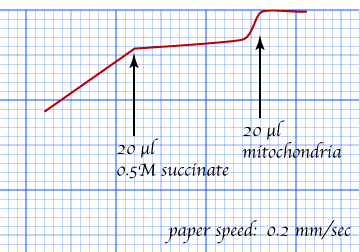
Mitochondria followed by succinate. The best volume of mitochondria to use depends on the quality of an individual preparation. The concentration of any substrate is high enough that its availability will not be rate-limiting for the duration of the experiment.
Trace #2
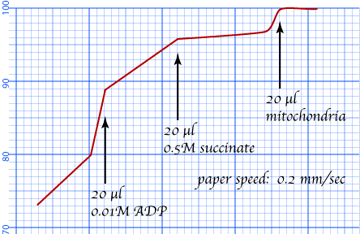
This trace shows what happens when we add a limited amount of ADP to mitochondria in the presence of a substrate. For the paper you will need to calculate the amount (in micromoles) of ADP added. You will also need to calculate the amount of oxygen that was consumed during ADP-stimulated respiration, in order to determine an ADP:O ratio.
Trace #3
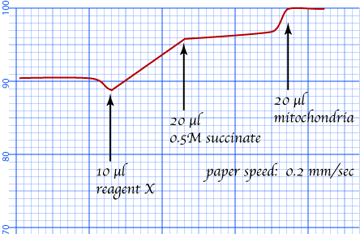
We will use poisons to study electron transport pathways and other properties of isolated mitochondria. Here, your task is to figure out what "reagent x" might be doing.
Trace #4
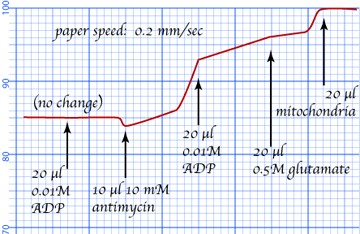
Sometimes a lack of response is as informative as an actual response. In fact, many experiments produce a "null" result. What condition of these mitochondria could account for the lack of a response to adding ADP?

Trace #5
We used a different substrate this time. Compare glutamate-stimulated respiration to succinate-stimulated respiration. Notice that antimycin produced the same effect as "reagent x," earlier. Notice also that in the presence of antimycin, adding ADP produces no change in oxygen consumption. Why?

Visitors: to ensure that your message is not mistaken for SPAM, please include the acronym "Bios211" in the subject line of e-mail communications
Created by David R. Caprette (caprette@rice.edu), Rice University 20 Sep 07