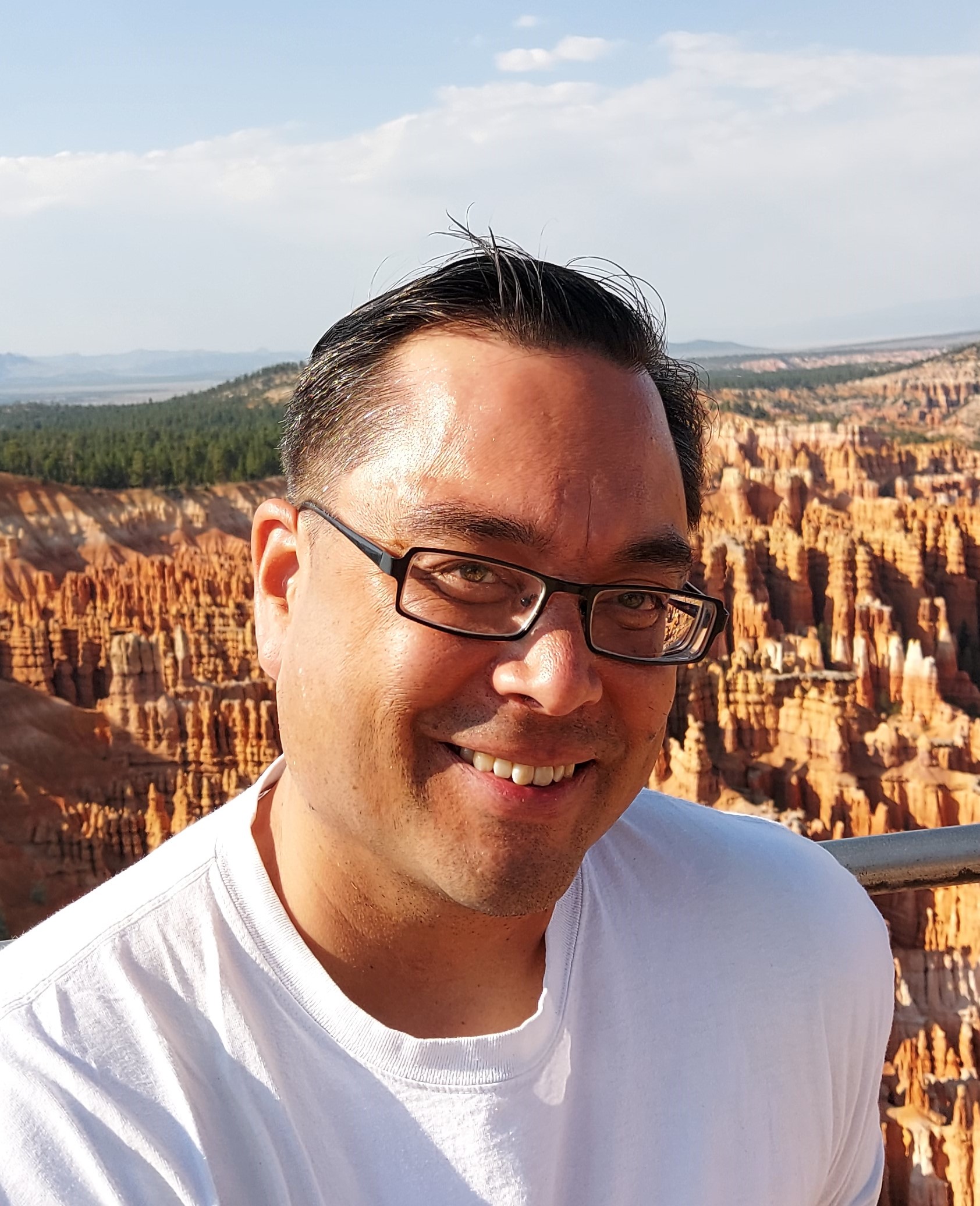
David Damanik
Robert L. Moody, Sr. Professor of Mathematics
Contact Information
Office: Room
434, Herman Brown Hall
Phone: (713) 348-3273
Fax: (713)
348-5231
E-mail: [my last name] at rice dot edu
Mailing address: Department of Mathematics, MS-136, Rice University, Houston, TX 77251
Degrees
Dr. phil. nat., Johann Wolfgang Goethe-Universität, Frankfurt, Germany, 1998
Dipl.-Inform., Johann Wolfgang Goethe-Universität, Frankfurt, Germany, 1996
Dipl.-Math., Johann Wolfgang Goethe-Universität, Frankfurt, Germany, 1995
Research Interests
Spectral Theory, Dynamical Systems, Aperiodic Order
Publications
-
One-Dimensional Ergodic Schrödinger Operators, II. Specific Classes (with Jake Fillman), Graduate Studies in Mathematics 249, American Mathematical Society, 2024.
-
Local existence and uniqueness of spatially quasi-periodic solutions to the generalized KdV equation (with Yong Li, Fei Xu), J. Math. Pures Appl. 186 (2024), 251-302.
-
The quasi-periodic Cauchy problem for the generalized Benjamin-Bona-Mahony equation on the real line (with Yong Li, Fei Xu), J. Funct. Anal. 286 (2024), Paper No. 110238, 39 pp.
-
The rotation number for the Schrödinger operator with alpha-norm almost periodic measures (with Gang Meng, Meirong Zhang, Zhe Zhou), Math. Z. 307 (2024), Paper No. 71, 27 pp.
-
The rotation number for almost periodic potentials with jump discontinuities and delta-interactions (with Meirong Zhang, Zhe Zhou), Ann. Henri Poincaré 25 (2024), 1359-1397.
-
Discontinuities of the integrated density of states for Laplacians associated with Penrose and Ammann-Beenker tilings (with Mark Embree, Jake Fillman, May Mei), Exp. Math. 33 (2024), 588-610.
-
Gap labels for zeros of the partition function of the 1D Ising model via the Schwartzman homomorphism (with Mark Embree, Jake Fillman), Indag. Math. 35 (2024), 813-836.
-
Schrödinger operators with potentials generated by hyperbolic transformations: I. Positivity of the Lyapunov exponent (with Artur Avila, Zhenghe Zhang), Invent. Math. 231 (2023), 851-927.
-
The spectrum of Schrödinger operators with randomly perturbed ergodic potentials (with Artur Avila, Anton Gorodetski), Geom. Funct. Anal. 33 (2023), 364-375.
-
The almost sure essential spectrum of the doubling map model is connected (with Jake Fillman), Commun. Math. Phys. 400 (2023), 793-804.
-
The Schwartzman group of an affine transformation (with Íris Emilsdóttir, Jake Fillman), J. Spectr. Theory 13 (2023), 1281-1296.
-
Johnson-Schwartzman gap labelling for ergodic Jacobi matrices (with Jake Fillman, Zhenghe Zhang), J. Spectr. Theory 13 (2023), 297-318.
-
Thin spectra and singular continuous spectral measures for limit-periodic Jacobi matrices (with Jake Fillman, Chunyi Wang), Math. Nachr. 296 (2023), 4279-4297.
-
Gap labelling for discrete one-dimensional ergodic Schrödinger operators (with Jake Fillman), From Complex Analysis to Operator Theory - A Panorama Oper. Theory Adv. Appl. 291, 341-404, Birkhäuser/Springer, Cham, 2023
-
One-Dimensional Ergodic Schrödinger Operators, I. General Theory (with Jake Fillman), Graduate Studies in Mathematics 221, American Mathematical Society, 2022.
-
Simon's OPUC Hausdorff dimension conjecture (with Shuzheng Guo, Darren Ong), Math. Ann. 384 (2022), 247-283
-
Must the spectrum of a random Schrödinger operator contain an interval? (with Anton Gorodetski), Commun. Math. Phys. 393 (2022), 1583-1613.
-
Absolutely continuous spectrum for CMV matrices with small quasi-periodic Verblunsky coefficients (with Long Li, Qi Zhou), Trans. Amer. Math. Soc. 375 (2022), 6093-6125
-
Absence of absolutely continuous spectrum for generic quasi-periodic Schrödinger operators on the real line (with Daniel Lenz), Israel J. Math. 247 (2022), 783-796
-
Zero measure spectrum for multi-frequency Schrödinger operators (with Jon Chaika, Jake Fillman, Philipp Gohlke), J. Spectr. Theory 12 (2022), 573-590
-
Cantor spectrum for CMV matrices with almost periodic Verblunsky coefficients (with Long Li, Qi Zhou), J. Funct. Anal. 283 (2022), Paper No. 109709
-
Subordinacy theory for extended CMV matrices (with Shuzheng Guo, Darren Ong), Sci. China Math. 65 (2022), 539-558.
-
The rotation number for almost periodic Schrödinger operators with $\delta$-potentials (with Zhe Zhou), J. Dynam. Differential Equations 34 (2022), 155-177
-
Szego's theorem for canonical systems: the Arov gauge and a sum rule (with Benjamin Eichinger, Peter Yuditskii), J. Spectr. Theory 11 (2021), 1255-1277
-
Ergodic Schrödinger operators in the infinite measure setting (with Michael Boshernitzan, Jake Fillman, Milivoje Lukic), J. Spectr. Theory 11 (2021), 873--902
-
Multidimensional Schrödinger operators whose spectrum features a half line and a Cantor set (with Jake Fillman, Anton Gorodetski), J. Funct. Anal. 280 (2021), 108911, 38 pp
-
Random Hamiltonians with arbitrary point interactions in one dimension (with Jake Fillman, Mark Helman, Jacob Kesten, Selim Sukhtaiev), J. Differential Equations 282 (2021), 104-126
-
Schrödinger operators generated by locally constant functions on the Fibonacci subshift (with Licheng Fang, Hyunkyu Jun), Ann. Henri Poincaré 22 (2021), 1459-1498
-
Lyapunov exponents: recent applications of Furstenberg's theorem in spectral theory, MATRIX Annals, MATRIX Book Ser. 4, Springer, Cham (2021), 685--689
-
Localization for Anderson models on metric and discrete tree graphs (with Jake Fillman, Selim Sukhtaiev), Math. Ann. 376 (2020), 1337-1393
-
Generic spectral results for CMV matrices with dynamically defined Verblunsky coefficients (with Licheng Fang, Shuzheng Guo), J. Funct. Anal. 279 (2020), 108803, 22 pp
-
Limit-periodic Schrödinger operators with a discontinuous Lyapunov exponent (with Zheng Gan, Helge Krüger), J. Funct. Anal. 279 (2020), 108565, 16 pp
-
Zero measure and singular continuous spectra for quantum graphs (with Licheng Fang, Selim Sukhtaiev), Ann. Henri Poincaré 21 (2020), 2167-2191
-
Random Sturm-Liouville operators with generalized point interactions (with Rafael del Rio, Asaf L. Franco), Oper. Matrices 14 (2020), 1101-1125
-
Localization for the one-dimensional Anderson model via positivity and large deviations for the Lyapunov exponent (with Valmir Bucaj, Jake Fillman, Vitaly Gerbuz, Tom VandenBoom, Fengpeng Wang, Zhenghe Zhang), Trans. Amer. Math. Soc. 372 (2019), 3619-3667
-
Positive Lyapunov exponents and a large deviation theorem for continuum Anderson models, briefly (with Valmir Bucaj, Jake Fillman, Vitaly Gerbuz, Tom VandenBoom, Fengpeng Wang, Zhenghe Zhang), J. Funct. Anal. 277 (2019), 3179-3186
-
Anderson localization for radial tree graphs with random branching numbers (with Selim Sukhtaiev), J. Funct. Anal. 277 (2019), 418-433
-
Anderson localization for quasi-periodic CMV matrices and quantum walks (with Fengpeng Wang), J. Funct. Anal. 276 (2019), 1978-2006
-
Multidimensional almost-periodic Schrödinger operators with Cantor spectrum (with Jake Fillman and Anton Gorodetski), Ann. Henri Poincaré 20 (2019), 1393-1402
-
Limit-periodic Schrödinger operators with Lipschitz continuous IDS (with Jake Fillman), Proc. Amer. Math. Soc. 147 (2019), 1531-1539
-
Almost periodicity in time of solutions of the KdV equation (with Ilia Binder, Michael Goldstein, Milivoje Lukic), Duke Math. J. 167 (2018), 2633-2678
-
Homogeneity of the spectrum for quasi-periodic Schrödinger operators (with Michael Goldstein, Wilhelm Schlag, Mircea Voda), J. Eur. Math. Soc. 20 (2018), 3073-3111
-
Spectral transitions for the square Fibonacci Hamiltonian (with Anton Gorodetski), J. Spectr. Theory 8 (2018), 1487-1507
-
Almost-periodicity in time of solutions of the Toda lattice (with Ilia Binder, Milivoje Lukic, and Tom VandenBoom), C. R. Math. Rep. Acad. Sci. Canada 40 (2018), 1-28
-
The isospectral torus of quasi-periodic Schrödinger operators via periodic approximations (with Michael Goldstein and Milivoje Lukic), Invent. Math. 207 (2017), 895-980
-
Schrödinger operators with dynamically defined potentials, Ergodic Theory Dynam. Systems 37 (2017), 1681-1764
-
Limit-periodic continuum Schrödinger operators with zero measure Cantor spectrum (with Jake Fillman and Milivoje Lukic), J. Spectr. Theory 7 (2017), 1101-1118
-
A multi-scale analysis scheme on Abelian groups with an application to operators dual to Hill's equation (with Michael Goldstein and Milivoje Lukic), Trans. Amer. Math. Soc. 369 (2017), 1689-1755
-
On the existence and uniqueness of global solutions for the KdV equation with quasi-periodic initial data (with Michael Goldstein), J. Amer. Math. Soc. 29 (2016), 825-856
-
The Fibonacci Hamiltonian (with Anton Gorodetski and William Yessen), Invent. Math. 206 (2016), 629-692
-
An extension of the Kunz-Souillard approach to localization in one dimension and applications to almost-periodic Schrödinger operators (with Anton Gorodetski), Adv. Math. 297 (2016), 149-173
-
Counterexamples to the Kotani-Last conjecture for continuum Schrödinger operators via character-automorphic Hardy spaces (with Peter Yuditskii), Adv. Math. 293 (2016), 738-781
-
Spreading estimates for quantum walks on the integer lattice via power-law bounds on transfer matrices (with Jake Fillman and Darren Ong), J. Math. Pures Appl. 105 (2016), 293-341
-
On anomalous Lieb-Robinson bounds for the Fibonacci XY chain (with Marius Lemm, Milivoje Lukic and William Yessen), J. Spectr. Theory 6 (2016), 601-628
-
The spectrum of a Schrödinger operator with small quasi-periodic potential is homogeneous (with Michael Goldstein and Milivoje Lukic), J. Spectr. Theory 6 (2016), 415-427
-
Quantum intermittency for sparse CMV matrices with an application to quantum walks on the half-line (with Jon Erickson, Jake Fillman, Gerhardt Hinkle, Alan Vu), J. Approx. Theory 208 (2016), 59-84
-
What is ... aperiodic order? (with Michael Baake and Uwe Grimm), Notices Amer. Math. Soc. 63 (2016), 647-650
-
Characterizations of uniform hyperbolicity and spectra of CMV matrices (with Jake Fillman, Milivoje Lukic, and William Yessen), Discrete Contin. Dyn. Syst. S 9 (2016), 1009-1023
-
Open problems and conjectures related to the theory of mathematical quasicrystals (with Faustin Adiceam, Franz Gähler, Uwe Grimm, Alan Haynes, Antoine Julien, Andrés Navas, Lorenzo Sadun and Barak Weiss), Arnold Math. J. 2 (2016), 579-592
-
Absolutely continuous convolutions of singular measures and an application to the square Fibonacci Hamiltonian (with Anton Gorodetski and Boris Solomyak), Duke Math. J. 164 (2015), 1603-1640
-
Quantum dynamics of periodic and limit-periodic Jacobi and block Jacobi matrices with applications to some quantum many body problems (with Milivoje Lukic and William Yessen), Commun. Math. Phys. 337 (2015), 1535-1561
-
Almost sure frequency independence of the dimension of the spectrum of Sturmian Hamiltonians (with Anton Gorodetski), Commun. Math. Phys. 337 (2015), 1241-1253
-
Uniform hyperbolicity for Szego cocycles and applications to random CMV matrices and the Ising model (with Jake Fillman, Milivoje Lukic, and William Yessen), Int. Math. Res. Not. 2015 (2015), 7110-7129
-
Almost ballistic transport for the weakly coupled Fibonacci Hamiltonian (with Anton Gorodetski), Israel J. Math. 206 (2015), 109-126
-
Transport exponents of Sturmian Hamiltonians (with Anton Gorodetski, Qinghui Liu, and Yanhui Qu), J. Funct. Anal. 269 (2015), 1404-1440
-
Spectral properties of Schrödinger operators arising in the study of quasicrystals (with Anton Gorodetski and Mark Embree), Mathematics of Aperiodic Order, Birkhäuser/Springer (2015), 307-370
-
On the inverse spectral problem for the quasi-periodic Schrödinger equation (with Michael Goldstein), Publ. Math. Inst. Hautes Études Sci. 119 (2014), 217-401
-
Singular density of states measure for subshift and quasi-periodic Schrödinger operators (with Artur Avila and Zhenghe Zhang), Commun. Math. Phys. 330 (2014), 469-498
-
New anomalous Lieb-Robinson bounds in quasiperiodic XY chains (with Marius Lemm, Milivoje Lukic and William Yessen), Phys. Rev. Lett. 113 (2014), 127202
-
Dynamics of unitary operators (with Jake Fillman and Robert Vance), J. Fractal Geom. 1 (2014), 391-425
-
Continuum Schrödinger operators associated with aperiodic subshifts (with Jake Fillman and Anton Gorodetski), Ann. Henri Poincaré 15 (2014), 1123-1144 (This paper was awarded the 2014 Annales Henri Poincaré Prize.)
-
Hölder continuity of the integrated density of states for the Fibonacci Hamiltonian (with Anton Gorodetski), Commun. Math. Phys. 323 (2013), 497-515
-
Limit-periodic Schrödinger operators on Z^d: Uniform localization (with Zheng Gan), J. Funct. Anal. 265 (2013), 435-448
-
Orthogonal polynomials on the unit circle with Fibonacci Verblunsky coefficients, I. The essential support of the measure (with Paul Munger and William Yessen), J. Approx. Theory 173 (2013), 56-88
-
Orthogonal polynomials on the unit circle with Fibonacci Verblunsky coefficients, II. Applications (with Paul Munger and William Yessen), J. Stat. Phys. 153 (2013), 339-362
-
Opening gaps in the spectrum of strictly ergodic Schrödinger operators (with Artur Avila and Jairo Bochi), J. Eur. Math. Soc. 14 (2012), 61-106
-
The density of states measure of the weakly coupled Fibonacci Hamiltonian (with Anton Gorodetski), Geom. Funct. Anal. 22 (2012), 976-989
-
Spectral and quantum dynamical properties of the weakly coupled Fibonacci Hamiltonian (with Anton Gorodetski), Commun. Math. Phys. 305 (2011), 221-277
-
A continuum version of the Kunz-Souillard approach to localization in one dimension (with Günter Stolz), J. Reine Angew. Math. 660 (2011), 99-130
-
Limit-periodic Schrödinger operators with uniformly localized eigenfunctions (with Zheng Gan), J. d'Analyse Math. 115 (2011), 33-49
-
Spectral properties of limit-periodic Schrödinger operators (with Zheng Gan), Commun. Pure Appl. Anal. 10 (2011), 859-871
-
Perturbations of orthogonal polynomials with periodic recursion coefficients (with Rowan Killip and Barry Simon), Ann. of Math. 171 (2010), 1931-2010
-
Limit-periodic Schrödinger operators in the regime of positive Lyapunov exponents (with Zheng Gan), J. Funct. Anal. 258 (2010), 4010-4025
-
A general description of quantum dynamical spreading over an orthonormal basis and applications to Schrödinger operators (with Serguei Tcheremchantsev), Discrete Contin. Dyn. Syst. A 28 (2010), 1381-1412
-
Cantor spectrum for Schrödinger operators with potentials arising from generalized skew-shifts (with Artur Avila and Jairo Bochi), Duke Math. J. 146 (2009), 253-280
-
The repetition property for sequences on tori generated by polynomials or skew-shifts (with Michael Boshernitzan), Israel J. Math. 174 (2009), 189-202
-
Schrödinger operators defined by interval exchange transformations (with Jon Chaika and Helge Krüger), J. Mod. Dyn. 3 (2009), 253-270
-
Almost periodic Szegö cocycles with uniformly positive Lyapunov exponents (with Helge Krüger), J. Approx. Theory 161 (2009), 813-818
-
Hyperbolicity of the trace map for the weakly coupled Fibonacci Hamiltonian (with Anton Gorodetski), Nonlinearity 22 (2009), 123--143
-
Quantum dynamical applications of Salem's theorem (with Rafael del Rio), Lett. Math. Phys. 22 (2009), 13-19
-
The spectrum of the weakly coupled Fibonacci Hamiltonian (with Anton Gorodetski), Electron. Res. Announc. Math. Sci. 16 (2009), 23-29
-
Almost everything about the Fibonacci operator, New Trends in Mathematical Physics, Selected contributions of the XVth International Congress on Mathematical Physics, Springer (2009), 149-159
-
Pinned repetitions in symbolic flows: preliminary results (with Michael Boshernitzan), Discrete Contin. Dyn. Syst. 2009, Dynamical Systems, Differential Equations and Applications. 7th AIMS Conference, suppl. (2009), 869-878
-
Absolute continuity of the integrated density of states for the almost Mathieu operator with non-critical coupling (with Artur Avila), Invent. Math. 172 (2008), 439-453
-
Generic continuous spectrum for ergodic Schrödinger
operators (with Michael Boshernitzan), Commun. Math. Phys. 283 (2008), 647-662
-
The fractal dimension of the spectrum of the Fibonacci Hamiltonian (with Mark Embree, Anton Gorodetski, and Serguei Tcheremchantsev), Commun. Math. Phys. 280 (2008), 499-516
- The analytic theory of matrix orthogonal polynomials (with Alexander Pushnitski and Barry Simon), Surv. Approx. Theory 4 (2008), 1-85
-
Quantum dynamics via complex analysis methods: general upper bounds without time-averaging and tight lower bounds for the strongly coupled Fibonacci Hamiltonian (with Serguei Tcheremchantsev), J. Funct. Anal. 255 (2008), 2872-2887
- Lyapunov exponents of continuous Schrödinger cocycles over irrational
rotations (with Kristian Bjerklöv and Russell Johnson), Ann. Mat. Pura Appl. 187 (2008), 1-6
- Upper bounds in quantum dynamics (with Serguei Tcheremchantsev), J. Amer. Math. Soc. 20 (2007), 799-827
- Schrödinger operators with many bound states (with Christian Remling), Duke Math. J. 136 (2007), 51-80
-
Unbounded Jacobi matrices at critical coupling (with Sergey Naboko),
J. Approx. Theory 145 (2007), 221-236
-
Uniform Szegö cocycles over strictly ergodic subshifts (with Daniel Lenz), J. Approx. Theory
144 (2007), 133-138
-
Bound states of discrete Schrödinger operators with super-critical inverse
square potentials (with Gerald Teschl), Proc. Amer. Math. Soc. 135 (2007), 1123-1127
- Lyapunov exponents and spectral analysis of ergodic Schrödinger operators: A
survey of Kotani theory and its applications, Spectral theory and mathematical physics: a Festschrift in honor of Barry Simon's 60th birthday, 539--563, Proc. Sympos. Pure Math., 76, Part 2, Amer. Math. Soc., Providence, RI, 2007
- Strictly ergodic subshifts and associated operators, Spectral theory and mathematical physics: a Festschrift in honor of Barry Simon's 60th birthday, 505--538, Proc. Sympos. Pure Math., 76, Part 2, Amer. Math. Soc., Providence, RI, 2007
- Jost functions and Jost solutions for Jacobi matrices, II. Decay and
analyticity (with Barry Simon), Int. Math. Res. Not. (2006), Article
ID 19396, 1-32
- Jost functions and Jost solutions for Jacobi matrices, I. A necessary
and sufficient condition for Szegö asymptotics (with Barry Simon), Invent. Math. 165 (2006), 1-50
- Lower transport bounds for one-dimensional continuum Schrödinger
operators (with Daniel Lenz and Günter Stolz), Math.
Ann. 336 (2006), 361-389
- Verblunsky coefficients with Coulomb-type decay, J.
Approx. Theory, 139 (2006), 257-268
- Zero-measure Cantor spectrum for Schrödinger operators with
low-complexity potentials (with Daniel Lenz), J. Math. Pures
Appl. 85 (2006), 671-686
- A criterion of Boshernitzan and uniform convergence in the
multiplicative ergodic theorem (with Daniel Lenz), Duke
Math. J. 133 (2006), 95-123
- Substitution dynamical systems: characterization of linear
repetitivity and applications (with Daniel Lenz), J.
Math. Anal. Appl. 321 (2006), 766-780
- Generic singular spectrum for ergodic Schrödinger operators (with Artur
Avila), Duke Math. J. 130 (2005), 393-400
- Scaling estimates for solutions and dynamical lower bounds on wavepacket
spreading (with Serguei Tcheremchantsev), J. d'Analyse Math. 97
(2005), 103-131
- Schrödinger operators with few bound states (with Rowan Killip and Barry
Simon), Commun. Math. Phys. 258 (2005), 741-750
- Almost everywhere positivity of the Lyapunov exponent for the doubling
map (with Rowan Killip), Commun. Math. Phys. 257
(2005), 287-290
- Ergodic potentials with a discontinuous sampling function are
non-deterministic (with Rowan Killip), Math. Res. Lett. 12
(2005), 187-192
- Dynamical upper bounds for one-dimensional quasicrystals,
J. Math. Anal. Appl. 303 (2005), 327-341
- Half-line Schrödinger operators with no bound states (with Rowan Killip),
Acta Math. 193 (2004), 31-72
- Power-law bounds on transfer matrices and quantum dynamics in one
dimension, II (with András Sütö and Serguei Tcheremchantsev), J. Funct. Anal.
216 (2004), 362-387
- Necessary and sufficient conditions in the spectral theory of Jacobi
matrices and Schrödinger operators (with Rowan Killip and Barry Simon), Int. Math. Res. Not. (2004),
no. 22, 1087-1097
- Localization for discrete one-dimensional random word models (with Robert
Sims and Günter Stolz), J. Funct. Anal. 208 (2004), 423-445
- A version of Gordon's theorem for multi-dimensional Schrödinger operators, Trans. Amer. Math. Soc.
356 (2004), 495-507
- Half-line eigenfunction estimates and singular continuous spectrum of zero Lebesgue
measure (with Daniel Lenz), Forum Math. 16 (2004), 109-128
- Reflection symmetries and absence of eigenvalues for one-dimensional
Schrödinger operators (with Dirk Hundertmark), Proc. Amer. Math. Soc. 132 (2004), 1957-1962
- Palindrome complexity (with Jean-Paul Allouche, Michael Baake and Julien Cassaigne), Theoret. Comput. Sci.
292 (2003), 9-31
- Powers in Sturmian sequences (with Daniel Lenz), European
J. Combin. 24 (2003), 377-390
- Log-dimensional spectral properties of one-dimensional quasicrystals (with Michael
Landrigan), Proc. Amer. Math. Soc.
131 (2003), 2209-2216
- Power-law bounds on transfer matrices and quantum dynamics in one
dimension (with Serguei Tcheremchantsev), Commun.
Math. Phys. 236 (2003), 513-534
- Variational estimates for discrete Schrödinger operators with potentials of indefinite
sign (with Dirk Hundertmark, Rowan Killip, and Barry Simon), Commun. Math. Phys.
238 (2003), 545-562
- Uniform spectral properties of one-dimensional quasicrystals, IV. Quasi-Sturmian
potentials (with Daniel Lenz), J. d'Analyse Math.
90 (2003), 115-139
- Quantum dynamical bounds for one-dimensional quasicrystals, Contemp. Math. 327 (2003), 87-97
- Combinatorial properties of Arnoux-Rauzy subshifts
and applications to Schrödinger operators (with Luca Q. Zamboni), Rev. Math. Phys. 15 (2003), 745-763
- Bound states and the Szegö condition for Jacobi matrices and
Schrödinger operators (with Dirk Hundertmark and Barry Simon), J. Funct. Anal.
205 (2003), 357-379
- The index of Sturmian sequences (with Daniel Lenz), European J. Combin. 23 (2002), 23-29
- Some high-complexity Hamiltonians with purely singular continuous spectrum (with Boris
Solomyak), Ann. Henri Poincare 3 (2002), 99-105
- Lyapunov exponents in continuum Bernoulli-Anderson models (with Robert
Sims and Günter Stolz), Operator Theory: Advances and Applications 132,
Birkhäuser, Basel (2002), pp. 121-130
- Localization for one-dimensional, continuum, Bernoulli-Anderson models (with Robert Sims
and Günter Stolz), Duke Math. J. 114 (2002),
59-100
- Absence of eigenvalues for a class of Schrödinger operators on the
strip, Forum Math. 14 (2002), 797-806.
- Linearly recurrent circle map subshifts and an application to
Schrödinger operators (with Boris Adamczewski), Ann. Henri Poincare 3
(2002), 1019-1047
- Multi-scale analysis implies strong dynamical localization (with Peter Stollmann), Geom.
Funct. Anal. 11 (2001), 11-29
- Uniform singular continuous spectrum for the period doubling Hamiltonian, Ann. Henri
Poincare 2 (2001), 101-108
- Spectral theory of Schrödinger operators with low-complexity potentials, Ferroelectrics
250 (2001), 143-149
- Linear repetitivity, I. Uniform subadditive ergodic theorems and
applications (with Daniel Lenz), Discrete Comput. Geom. 26 (2001),
411-428
- A palindromic half-line criterion for absence of eigenvalues and applications to
substitution Hamiltonians (with Jean-Michel Ghez and Laurent Raymond), Ann. Henri
Poincare 2 (2001), 927-939
- Local symmetries in the period doubling sequence, Discrete Appl. Math. 100
(2000), 115-121
- A generalization of Gordon's theorem and applications to quasiperiodic Schrödinger
operators (with Günter Stolz), Electron. J. Diff. Eqns. 2000 (2000), No.
55, pp. 1-8
- Palindrome complexity bounds for primitive substitution sequences (with Douglas Zare), Discrete
Math. 222 (2000), 259-267
- Substitution Hamiltonians with bounded trace map orbits, J. Math. Anal. Appl. 249
(2000), 393-411
- Gordon-type arguments in the spectral theory of one-dimensional quasicrystals, in Directions
in Mathematical Quasicrystals, M. Baake, R. V. Moody, eds., CRM Monograph Series 13,
AMS, Providence, RI (2000), pp. 277-304
- Reflection symmetries of almost periodic functions (with Rowan Killip), J. Funct.
Anal. 178 (2000), 251-257
- Singular continuous spectrum for a class of substitution Hamiltonians II., Lett.
Math. Phys. 54 (2000), 25-31
- Uniform spectral properties of one-dimensional quasicrystals, III. alpha-continuity
(with Rowan Killip and Daniel Lenz), Commun. Math. Phys. 212 (2000), 191-204
- Uniform spectral properties of one-dimensional quasicrystals, II. The Lyapunov exponent
(with Daniel Lenz), Lett. Math. Phys. 50 (1999), 245-257
- Uniform spectral properties of one-dimensional quasicrystals, I. Absence of eigenvalues
(with Daniel Lenz), Commun. Math. Phys. 207 (1999), 687-696
- Singular continuous spectrum for a class of substitution Hamiltonians, Lett. Math.
Phys. 46 (1998), 303-311
- Singular continuous spectrum for the period doubling Hamiltonian on a set of full
measure, Commun. Math. Phys. 196 (1998), 477-483
- alpha-continuity properties of one-dimensional quasicrystals, Commun. Math. Phys.
192 (1998), 169-182
Teaching
- MATH 220: Honors Ordinary Differential Equations (Fall 2024)
- MATH 425/515: Integration Theory (Fall 2024)
- MATH 220: Honors Ordinary Differential Equations (Spring 2024)
- MATH 471: Mathematics of Aperiodic Order (Spring 2024)
- MATH 220: Honors Ordinary Differential Equations (Spring 2023)
- MATH 523: Functional Analysis (Spring 2023)
- MATH 220: Honors Ordinary Differential Equations (Fall 2020)
- MATH 527: Ergodic Theory and Topological Dynamics (Fall 2020)
- MATH 220: Honors Ordinary Differential Equations (Spring 2020)
- MATH 435: Dynamical Systems (Spring 2020)
- MATH 220: Honors Ordinary Differential Equations (Fall 2018)
- MATH 368: Topics in Combinatorics (Fall 2018)
- MATH 238: Special Topics - Honors Ordinary Differential Equations (Fall 2017)
- MATH 471: Mathematics of Aperiodic Order (Fall 2017)
- MATH 425/515: Integration Theory (Fall 2014) course webpage (on OWL-Space)
- MATH 101: Single Variable Calculus I (Fall 2013) course webpage (on OWL-Space)
- MATH 471: Mathematics of Aperiodic Order (Fall 2013) course webpage
- MATH 435: Dynamical Systems (Spring 2012) course webpage
- MATH 521: Advanced Topics in Real Analysis (Spring 2012) course webpage
- MATH 471: Mathematics of Aperiodic Order (Fall 2010) course webpage
- MATH 521: Advanced Topics in Real Analysis (Fall 2010) course webpage
- MATH 435: Dynamical Systems (Fall 2009) course webpage
- MATH 521: Advanced Topics in Real Analysis (Fall 2009) course webpage
- MATH 426: Topics in Real Analysis (Spring 2009) course webpage
- MATH 522: Topics in Analysis (Spring 2009) course webpage
- MATH 423: Partial Differential Equations (Fall 2007) course webpage
- MATH 521: Advanced Topics in Real Analysis (Fall 2007) course webpage
- MATH 102: Single Variable Calculus II (Fall 2006) course webpage
- MATH 423: Partial Differential Equations (Fall 2006) course webpage
Meetings
- Spectral Theory and Mathematical Physics - A Conference in Honor of Barry Simon's 80th Birthday (with Jonathan Breuer,
Fritz Gesztesy, Sergei Gukov, Svetlana Jitomirskaya, Alexander Kiselev, Milivoje Lukic), Merkin Center for Pure and Applied Mathematics, Caltech, Pasadena, USA (April 27-May 1, 2026) webpage
- Workshop on Directions in Aperiodic Order (with Reem Yassawi, Natalie Frank,
Neil Manibo, Nicolae Strungaru), Banff International Research Station, Banff, Canada (July 27-August 1, 2025) webpage
- Conference on Algebra, Analysis, and Aperiodic Order (with Neil Manibo, Nicolae Strungaru), Universität Bielefeld, Bielefeld, Germany (August 12-16, 2024) webpage
- Workshop on Randomness and Quasiperiodicity in Mathematical Physics (with Wencai Liu, Constanza Rojas-Molina, Mira Shamis), Banff International Research Station, Banff, Canada (January 14-19, 2024) webpage
- Workshop on Aspects of Aperiodic Order (with Michael Baake, Maria Isabel Cortez, Nicolae Strungaru), Mathematisches Forschungsinstitut Oberwolfach, Oberwolfach, Germany (August 27-September 2, 2023) webpage
- Complex Analysis, Spectral Theory and Approximation Meet in Linz (with Benjamin Eichinger, Stanislas Kupin, Mikhail Sodin), Johannes Kepler University, Linz, Austria (July 3-8, 2022) webpage
- Workshop on Ergodic Operators and Quantum Graphs (with Jake Fillman, Selim Sukhtaiev), Simons Center for Geometry and Physics, Stony Brook, USA (June 6-10, 2022) webpage
- Ergodic Theory and its Connections: A Conference in Honor of the Legacy of Michael Boshernitzan (with Jon Chaika), Rice University, Houston, USA (May 19-22, 2022) webpage
- Workshop on Almost-Periodic Spectral Problems (with Svetlana Jitomirskaya, Leonid Parnovski), Banff International Research Station, Banff, Canada (April 17-22, 2022) webpage
- Special Session on Dynamical Systems (with Carlangelo Liverani), International Congress on Mathematical Physics, Geneva, Switzerland (August 2-7, 2021) webpage
- Special Session on Mathematical Methods in Quantum Mechanics (with Rafael Benguria, Cesar R. de Oliveira, Rafael del Rio, Julio H. Toloza), Mathematical Congress of the Americas, Buenos Aires, Argentina (July 19-24, 2021) webpage
- Texas Analysis and Mathematical Physics Symposium (with Thomas Chen), Online Conference (April 9-11, 2021) webpage
- Workshop on Geometry, Dynamics and Spectrum of Operators on Discrete Spaces (with Matthias Keller, Tatiana Nagnibeda, Felix Pogorzelski), Mathematisches Forschungsinstitut Oberwolfach, Oberwolfach, Germany (January 3-9, 2021) webpage
- Texas Analysis and Mathematical Physics Symposium (with Thomas Chen), Rice University, Houston, USA (January 31-February 2, 2020) webpage
- Workshop on Random Matrix Products and Anderson Localization (with Anton Gorodetski), Banff International Research Station, Banff, Canada (September 15-20, 2019) webpage
- Workshop on Spectral Theory of Quasi-Periodic and Random Operators (with Jonathan Breuer, Milivoje Lukic, Simone Warzel), CRM, Montreal, Canada (November 12-16, 2018) webpage
- Texas Analysis and Mathematical Physics Symposium (with Jon Harrison, Brian Simanek, Thomas Chen, Constanze Liaw), Baylor University, Waco, USA (October 26-28, 2018) webpage
- Texas Analysis and Mathematical Physics Symposium (with Thomas Chen), University of Texas, Austin, USA (November 3-5, 2017) webpage
- Mini-Workshop on Reflectionless Operators: The Deift and Simon Conjectures (with Fritz Gesztesy, Peter Yuditskii), Mathematisches Forschungsinstitut Oberwolfach, Oberwolfach, Germany (October 22-28, 2017) webpage
- Workshop on Spectral Structures and Topological Methods in Mathematical Quasicrystals (with Michael Baake, Johannes Kellendonk, Daniel Lenz), Mathematisches Forschungsinstitut Oberwolfach, Oberwolfach, Germany (October 1-7, 2017) webpage
- Texas Analysis and Mathematical Physics Symposium (with Thomas Chen), Rice University, Houston, USA (October 21-23, 2016) webpage
- Texas Analysis and Mathematical Physics Symposium (with Thomas Chen, Vladimir Dragovic), University of Texas, Dallas, USA (November 6-8, 2015) webpage
- Workshop on Spectral Properties of Quasicrystals via Analysis, Dynamics, and Geometric Measure Theory (with Anton Gorodetski), Banff International Research Station, Oaxaca, Mexico (September 27-October 2, 2015) webpage
- Minisymposium on Inverse Spectral Theory and Applications (with Gerald Teschl), Equadiff 2015, Lyon 1 University, France (July 6-10, 2015) webpage
- Program on Periodic and Ergodic Spectral Problems (with Svetlana Jitomirskaya, Frédéric Klopp, Leonid Parnovski, Alexander Sobolev), Isaac Newton Institute for Mathematical Sciences, Cambridge, UK (January 5-June 26, 2015) webpage
- Mini-Workshop on Dynamical versus Diffraction Spectra in the Theory of Quasicrystals (with Michael Baake, Uwe Grimm), Mathematisches Forschungsinstitut Oberwolfach, Oberwolfach, Germany (November 30-December 6, 2014) webpage
- Texas Analysis and Mathematical Physics Symposium (with Thomas Chen), University of Texas, Austin, USA (November 21-23, 2014) webpage
- Special Session on Dynamical Systems and Spectral Theory, 10th AIMS International Conference on Dynamical Systems, Differential Equations and Applications, ICMAT/UAM, Madrid, Spain (July 7-11, 2014) webpage
- Texas Analysis and Mathematical Physics Symposium (with Thomas Chen), Rice University, Houston, USA (October 25-27, 2013) webpage
- Mini-Workshop on Direct and Inverse Spectral Theory of Almost Periodic Operators (with Michael Goldstein), Mathematisches Forschungsinstitut Oberwolfach, Oberwolfach, Germany (July 21-27, 2013) webpage
- Workshop on Dynamical Methods in the Spectral Theory of Quasicrystals (with Anton Gorodetski, May Mei, William Yessen), UC Irvine, Irvine, USA, (May 16-19, 2013) webpage
- Recent Advances in Harmonic Analysis and Spectral Theory (with Andrew Comech, Constanze Liaw, Alexei Poltoratski), Texas A&M University, College Station, USA (August 6-10, 2012) webpage
- Special Session on Dynamical Systems and Spectral Theory, 9th AIMS International Conference on Dynamical Systems, Differential Equations and Applications, Hyatt Grand Cypress Resort, Orlando, USA (July 1-5, 2012) webpage
- Arbeitsgemeinschaft: Quasiperiodic Schrödinger Operators (with Artur Avila, Svetlana Jitomirskaya), Mathematisches Forschungsinstitut Oberwolfach, Oberwolfach, Germany (April 1-7, 2012) webpage
- Workshop on Almost Periodic Order: Spectral, Dynamical, and Stochastic Approaches (with Michael Baake, Daniel Lenz), Banff International Research Station, Banff, Canada (September 25-30, 2011) webpage
- Minisymposium on Spectral Theory and Dynamics of Cocycles (with Roberta Fabbri), Equadiff 2011, Loughborough University, Loughborough, UK (August 1-5, 2011) webpage
- Special Session on Spectral Theory (with Christian Remling), Spring AMS Central Section Meeting, University of Iowa, Iowa City, USA (March 18-20, 2011) webpage
- Mini-Workshop on Dynamics of Trace Maps and Applications to Spectral Theory (with Anton Gorodetski), Mathematisches Forschungsinstitut Oberwolfach, Oberwolfach, Germany (January 16-22, 2011) webpage
- Texas Geometry and Topology Conference (with Alexander Bufetov, Robert Hardt), Rice University, Houston, USA (November 6-8, 2009) webpage
- Mini-Workshop on the Pisot Conjecture - From Substitution Dynamical Systems to Rauzy Fractals and Meyer Sets (with Valérie Berthé, Daniel Lenz), Mathematisches Forschungsinstitut Oberwolfach, Oberwolfach, Germany (March 1-7, 2009) webpage
- Special Session on Dynamical Systems and Spectral Theory, 7th AIMS International Conference on Dynamical Systems, Differential Equations and Applications, University of Texas, Arlington, USA (May 18-21, 2008) webpage
- Mini-Workshop on the Dynamics of Cocycles and One-Dimensional Spectral Theory (with Russell Johnson, Daniel Lenz), Mathematisches Forschungsinstitut Oberwolfach, Oberwolfach, Germany (Novermber 13-19, 2005) webpage
- Workshop on Aperiodic Order: Dynamical Systems, Combinatorics, and Operators (with Michael Baake, Ian Putnam, Boris Solomyak), Banff International Research Station, Banff, Canada (May 29-June 3, 2004) webpage
Further Items
Click
here to get a listing of D. Damanik's papers from the AMS MathSciNet with links to
Mathematical Reviews.
(Note: You or your institution must have a valid MathSciNet subscription.)
Math Department Home Page