Rice University Campus Observatory [RUCO]
|

|
About the Observatory
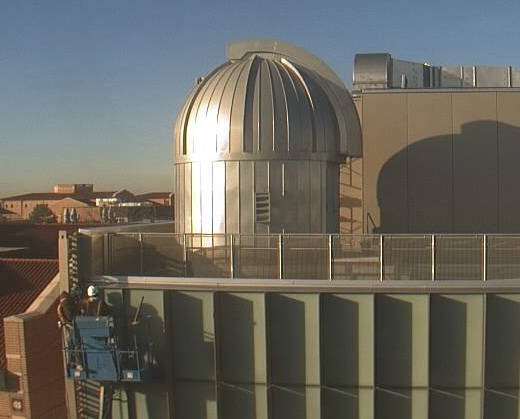
Operated by the Department of Physics and Astronomy, the Rice University Campus Observatory (RUCO) features a computerized 16" Meade telescope, and several smaller telescopes for use primarily in undergraduate courses at Rice. RUCO is situated on the a terrace on the eastern side of the roof of the Brockman Hall of Physics on campus. The observatory moved to this location early in 2011 and is in full operation. During the Academic Year (Sept through May) we typically hold open houses sometime during the weekend near the first quarter Moon, with a faculty member present to answer questions on astronomy. RUCO is normally closed during the summer months. Please refer to our schedule of open houses for dates and times.
Classes which make use of the observatory include
- Astr 101: Stars, Galaxies, and the Universe, an introductory astronomy course for non-majors
- Astr 102: Exploration of the Solar System, an introductory class in planetary science for non-science majors
- Astr 229 and ASTR 230: Astronomy Labs, the primary courses for Astronomy majors and others to learn to use a research caliber telescope and equipment including spectrometers and CCD imagers. In ASTR 229, students learn advanced image processing techniques which they use to analyze data taken with RUCO and McDonald Observatory telescopes. ASTR 230 focuses more on spectroscopy and computational skills, and students complete a final research project of their own design.
- Upper level courses may also make use of RUCO throughout the semester. Complete descriptions of the courses can be found here.
- We also offer special courses for teachers that use the observatory: ASTR502, ASTR503, and ASTR530.
The observatory is guided by a committee of faculty with Professor Patrick Hartigan as its chair.
More Information
For more information about astronomy at Rice please refer to the Physics and Astronomy Department home page. Additional space-related events of interest to the public can be found on the Rice Space Institute page.