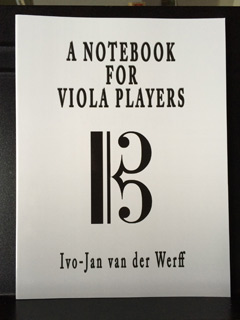
A Notebook for Viola Players
I am delighted to announce the publication of the 2nd edition of my book.
Essentially it is the same as the 1st but with a few additions, a new cover, a new introduction plus a note for those of smaller stature, and some additional notes relating to the various exercises throughout the book.
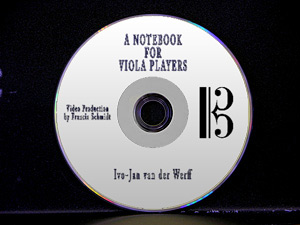
There is still a DVD with the book showing demonstrations of the various exercises.
The cost is $30 plus postage/packing.
I can accept a check made out to ‘Ivo van der Werff’ or I can accept credit/debit cards.
Please email me at iv3@rice.edu to place an order.
A Notebook for Viola Players is also available on Amazon and at various stores in the UK and USA such as Lisle Violins, Stamell Strings, Kensington Chimes, Blackwells and Violineri.
Reviews
A Notebook for Viola Players - Endorsements
Ivo-Jan van der Werff has very cleverly and clearly set out his ideas about basic technique in a way that can relate to many different kinds of violists, a unique achievement. I am certain the Notebook will become an important and useful resource for many players. It was of particular interest to me to see in print, for the first time, exercises devised by the great player and teacher Bruno Giuranna, with whom Ivo and I both studied.
Simon Rowland-Jones, violist, composer and editor of the new Peters Edition of the Haydn String Quartets and of the Bach Cello Suites for Viola
A Notebook for Viola Players" is a wonderful addition to the world of viola technique. Expertly offered with clarity, wit and elegance, it is eminently practical and compassionate!
James F. Dunham, Professor of Viola, Rice University, Shepherd School of Music; former violist: Sequoia and Cleveland Quartets
This is such a valuable fund of exercises, thoughtfully devised to build and maintain a foundation of technical security and quality. Players at all stages of their development will find both useful warm-ups and technique-enhancing challenges, presented in Ivo-Jan van der Werff's articulate, reassuring stye.
Roger Tapping, Professor of Viola, New England Conservatory; former violist Takacs and Allegri Quartets
This book gives a truly grounded and open approach to viola technique, imparting wisdom without unecessary fuss. There is a balance between indivdual needs and the fundamentals of a strong string players technique. The conclusion gives every instrumentalist food for thought, basics that all players should think of every day.
Edward Vanderspar, Principal Viola, London Symphony Orchestra
Excerpts from the book
 The number of ways to play the viola is determined by the number of violists in the world. Each player has (and should have) a unique technique, a unique sound and a unique way of interpreting music. Why should this be? Because each player is an individual, physically, emotionally and mentally. It would be so boring if every violist sounded the same. A unique voice is much more interesting and compelling. To this end we have to determine our approach to playing on every level. But, the basics of what we do are going to be very similar. The individuality comes later, when we can develop our techniques to express ourselves as unique voices. The basics are determined by the fact that the majority of us are born with two arms, two hands, two thumbs, eight fingers, two legs etc. The way we all walk is similar due to this, though everyone has an ‘individual’ and often recognizable walk. The physical movement involved in walking is based on common principles for almost everyone. So it should be in the way we set up the viola and our approach to it.
The position of the body, the way we stand or sit, the way we raise our arms to hold the viola and bow, the actual bow hold and the shape of the left hand, all these basic things can be approached from common physical principles even though every player is built differently. The wonderful thing about violists is not just the physical diversity of the people playing the viola but also in the diversity in the shape and size of the violas themselves. It can lead to challenging issues and resolutions to problems. Again, coming from common principles can help in deciding on all the variations of approach we have.
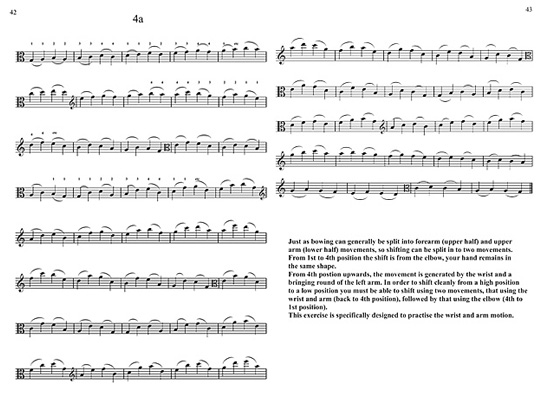
The one thing that every single violist can hopefully agree on is that we want to create the best sound possible. Why after all were we drawn to play this amazing instrument? Everything I suggest in the text and practiced in the exercises is to this one, basic, unifying principle. Sound is affected not just by the way we put the bow on the string but by the way we hold the viola, the way the fingers of the left hand approach the fingerboard, the quality of the vibrato, the way we stand and breathe, by intonation. The list goes on and on.
 Hopefully by reading through the text and playing the exercises in the ways suggested, you will gain a good understanding of how to create a great sound, how to allow the viola to resonate without forcing it, how to gain dexterity in both the bow and the left hand and how to play in a relaxed yet vital manner.
Ultimately, everything I suggest to think about in playing the viola should become natural and habitual. For those more advanced players trying this out for the first time, one of the toughest things is to overcome old, ingrained habits. Always remember the goal, don’t get discouraged and don’t rush. New habits take time to get bedded in. The goal is worth the physical and mental effort.
Posture
Many of the technical problems and faults viola players encounter can come down to posture, that is, the way we hold ourselves and our instruments.
Certain key words describe the attitude and approach we should have: poise, balance, weight (as opposed to force), flexibility. There are of course many more descriptive words that can be used, but these few give an idea of the general attitude, both physically and mentally that we should aspire to.
Holding and playing a viola is not exactly the most natural physical process and a lot of tension can arise from bad posture. It would seem obvious (although always less straight forward in practice) that while playing, the general posture must be as natural as possible. To this end we should observe the way we naturally stand. The feet should be slightly apart and flat on the floor, balancing between the heel and the ball of the foot. The legs, knees and hips should be relaxed. The lower and upper back should exhibit the natural curve of the spine (not holding it straight) but not leaning to the left or right. The shoulders should be down and the neck straight with the head balanced evenly. When we put the viola into position we should still have this basic, natural posture. The only thing that might change slightly is the position of the head, which might turn and drop fractionally into the chin rest……………..
Preliminary Bow Exercises
- Rest the middle of the bow on the D or G string. Make sure that the upper arm is parallel with the bow and that the elbow is neither too high nor too low. The wrist should be curved slightly downwards, the hand being just below the level of the forearm thereby ‘suspending’ the bow. Moving only from the shoulder (which should be relaxed downwards), keeping the shape of the arm and its relation to the bow constant and the bow always at right angles to the strings, move the bow from one string to the next. Go beyond the C string (so the bow hair even touches the wood of the viola) and beyond the A string in a similar manner. Make sure the movement is slow, even and relaxed. The shoulder acts as a pivot.
Repeat this exercise but now resting the bow at the point, and again with the bow at the heel. Be aware of any general differences in the movement of the arm.
- One thing that is very rarely practised, but vitally important, is actually ‘putting’ the bow on the string. The quality of sound we make depends as much (if not more) on our approach to the string as what we do when it is there.
Stand (or sit) with the viola in position. Swing the bow arm in a big arc from a resting position (ie by your side) away from the body (to the right), then up and over the viola so you approach the string from above. In this way you are working with gravity. Settle the bow on the string in the middle. Observe the shape of the arm, wrist and fingers. If they are incorrect decide what needs to be changed and go through the motion again. When you are satisfied, with the bow resting on the string, feel the weight of the arm via the hand (ultimately the index finger) going through the bow. Do not use ‘force’ or tension. The feeling should be like sitting on a very comfortable chair. The springs (strings) support your weight and your weight presses down in a relaxed manner into the chair (viola). It should be a secure and easy feeling. Try breathing in, then on the out breath, let the shoulders drop and settle into a relaxed position. This simple exercise should initially bepractised at the heel, middle, and point, and on each string in turn. When you have done this and feel comfortable, try ‘walking’ up and down the bow in the following manner. Place the bow at the heel and feel relaxed, note the position of the arm………