ASTR 565 (Compact Objects) provides a one semester, three credit, exploration of the astrophysics and physics of compact objects, principally the post-main-sequence white dwarfs, neutron stars and black holes. It is intended for graduate students with a considerable undergraduate background in physics: see Prerequisites for an indication of helpful background material. Strong senior undergraduates may also contemplate this course, which samples an intriguing blend of physics disciplines in its exploration of some of the most exotic phenomena in the universe. The course will not only interest those whose major focus is astrophysics, but will also resonate with students whose chosen discipline is nuclear or particle or condensed matter physics, or relativity, or plasma physics. Hence, ASTR 565 possesses broad appeal.
Astrophysical contexts for this subject range from post main sequence stars in the solar neighbourhood, to neutron stars strewn through the galaxy, to microquasars, to the black hole at the center of the Milky Way, to magnetars and relativistic, binary pulsars, to monster accreting black holes at the centers of active galaxies, to the bases of quasar jets, and to gamma-ray bursts. This disparate array of environments provides a broad range of astronomical signals, spanning all the wavebands from the radio to high energy gamma-rays, each providing a unique probe for a given system. Reflecting the intrinsic nature of compact stars and black holes, and also research interests of the Instructor, the course material will naturally emphasize topics central to the mission of the Relativistic Astrophysics and Cosmology group in the Department of Physics and Astronomy.
ASTR 565 begins with an astrophysical overview of the origin and occurrence of compact objects in the cosmos, highlighting specific examples that are particularly topical at the moment. Then it plunges into the nitty gritty of condensed stellar forms, starting with white dwarfs, electron degeneracy, equations of state, the Oppenheimer-Volkov equation, the mass-radius relation and the Chandrasekhar mass limit. Then issues of white dwarf cooling and crystallization are briefly explored.
The next focus is neutron stars. At this juncture, it is necessary to introduce basic concepts from general relativity, with a brief foray into relativistic stability of compact stars. Then stellar rotation, and strong magnetic field development will be considered to complete the preparation for neutron star studies, which will begin with the exploration of nuclear/particle physics of their interiors. Neutron star models, masses and their cooling will then be examined, culminating in an exposition on their principal observational manifestation: pulsars. This will include magnetospheric geometry, spin-down, surface and magnetospheric emission mechanisms, the radio pulsar death line, and glitch activity. A side venture to the exotic world of magnetars will then be on the agenda.
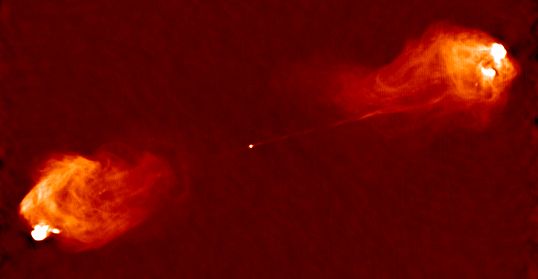
Our final stellar focus will be black holes, considering first the Schwarzschild solution, Kerr black holes and evaporation. Then gravitational radiation, LIGO sources and binary pulsars will be treated. Next stop on this theme park ride will be the exploraton of accretion of matter onto black holes and neutron stars, the character of disks, and the observational signatures of astrophysical jets. In galactic environs this will address X-ray binaries and microquasars, and then segue into the extragalactic contexts of supermassive black holes, quasars and blazars. If time permits, we will also foray briefly into the topical world of gamma-ray bursts.
For a more extensive, illustrated outline of the material covered, go to the Compact Objects page.