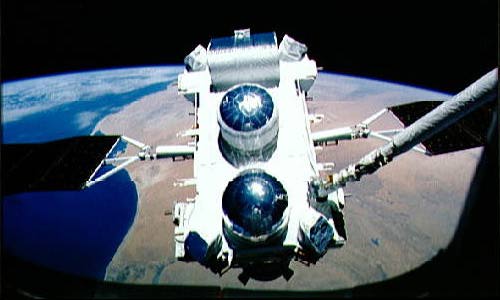
As a brief introduction to ASTR 565, to supplement the Course Description, here we survey the course, which provides an in-depth, basic study of the astrophysics and pertinent physics of some of the most exotic and fascinating objects that are found in the Milky Way and in distant galaxies. This gallery is a representative (but of course incomplete) sampling of the material covered in the course.
 Compact, post-main sequence stars in the Milky Way and beyond display a
remarkable array of phenomena that have fascinated astronomers and
physicists since the discovery of white dwarfs in the middle of the 19th
Century. Neutron stars and black holes were envisaged first as
theoretical concepts, spawned by the advances in relativity, quantum
mechanics and nuclear physics in the ``golden age'' of physics in the
early part of the 20th Century. Their observational confirmations over
the last 4 decades has been spawned by technological advances in various
wavebands. This course explores our current understanding of these
objects, with a principal focus being on the physics of their galactic
manifestations, but also providing discussion of the extragalactic
environments of supermassive black holes and gamma-ray bursts.
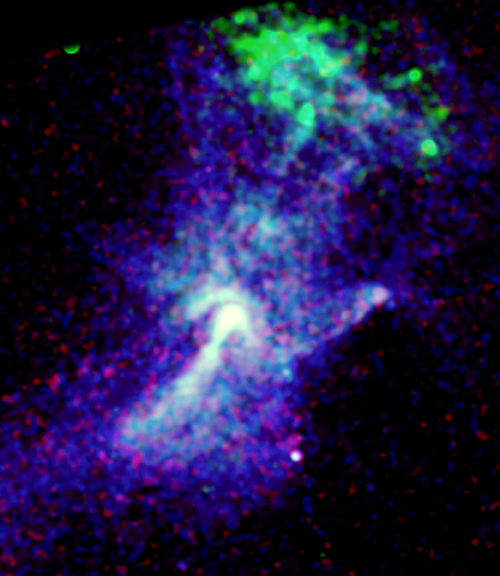
At left is a Chandra Observatory
X-ray image of the wind nebula and jet surrounding the pulsar PSR 1509-58.
Compact, post-main sequence stars in the Milky Way and beyond display a
remarkable array of phenomena that have fascinated astronomers and
physicists since the discovery of white dwarfs in the middle of the 19th
Century. Neutron stars and black holes were envisaged first as
theoretical concepts, spawned by the advances in relativity, quantum
mechanics and nuclear physics in the ``golden age'' of physics in the
early part of the 20th Century. Their observational confirmations over
the last 4 decades has been spawned by technological advances in various
wavebands. This course explores our current understanding of these
objects, with a principal focus being on the physics of their galactic
manifestations, but also providing discussion of the extragalactic
environments of supermassive black holes and gamma-ray bursts.
At left is a Chandra Observatory
X-ray image of the wind nebula and jet surrounding the pulsar PSR 1509-58.
 The course begins with an astrophysical overview of the origin and
occurrence of compact objects in the cosmos, highlighting specific
examples that are have been particularly interesting and those that are
topical at the moment. Then it focuses on the details of condensed
stellar forms, starting with white dwarf stars. This material then
addresses the most pertinent issue of electron degeneracy, and how this
impacts the equation of state and the hydrostatic structure in the
interior of white dwarfs. Signature properties such as the mass-radius
relation and the Chandrasekhar mass limit are highlighted. Then our
attention turns to neutronization and pyconuclear reactions in condensed
dwarf interiors. Subsequently, properties of white dwarf cooling and
crystallization are explored, noting how these can lead to using white
dwarfs as a chronometer for our universe.
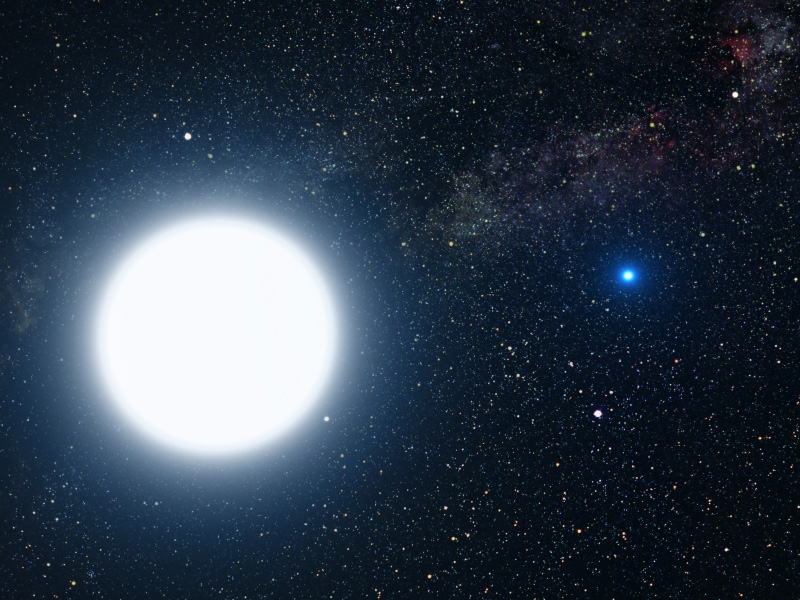
To the right is an artist's depiction using optical
Hubble Space Telescope
images of the first known white dwarf, Sirius B (small blue star) together with its
brighter main sequence companion Sirius A (the Dog Star).
The course begins with an astrophysical overview of the origin and
occurrence of compact objects in the cosmos, highlighting specific
examples that are have been particularly interesting and those that are
topical at the moment. Then it focuses on the details of condensed
stellar forms, starting with white dwarf stars. This material then
addresses the most pertinent issue of electron degeneracy, and how this
impacts the equation of state and the hydrostatic structure in the
interior of white dwarfs. Signature properties such as the mass-radius
relation and the Chandrasekhar mass limit are highlighted. Then our
attention turns to neutronization and pyconuclear reactions in condensed
dwarf interiors. Subsequently, properties of white dwarf cooling and
crystallization are explored, noting how these can lead to using white
dwarfs as a chronometer for our universe.
To the right is an artist's depiction using optical
Hubble Space Telescope
images of the first known white dwarf, Sirius B (small blue star) together with its
brighter main sequence companion Sirius A (the Dog Star).
 After a brief encounter with stellar stability, the subject matter turns
to general relativity, a necessary prerequisite for our studies of both
neutron stars and black holes. The lectures summarize metrics, the
Equivalence principal, Einstein's field equations, gravitational
redshift, and introduce the Schwarzschild solution for static,
spherically symmetric systems. The lynchpin physical tests of Einstein's
theory are addressed, specifically light deflection and precession of
the perihelia. Exploration of gravitational radiation is deferred to
later in the course, when binary pulsars are discussed.
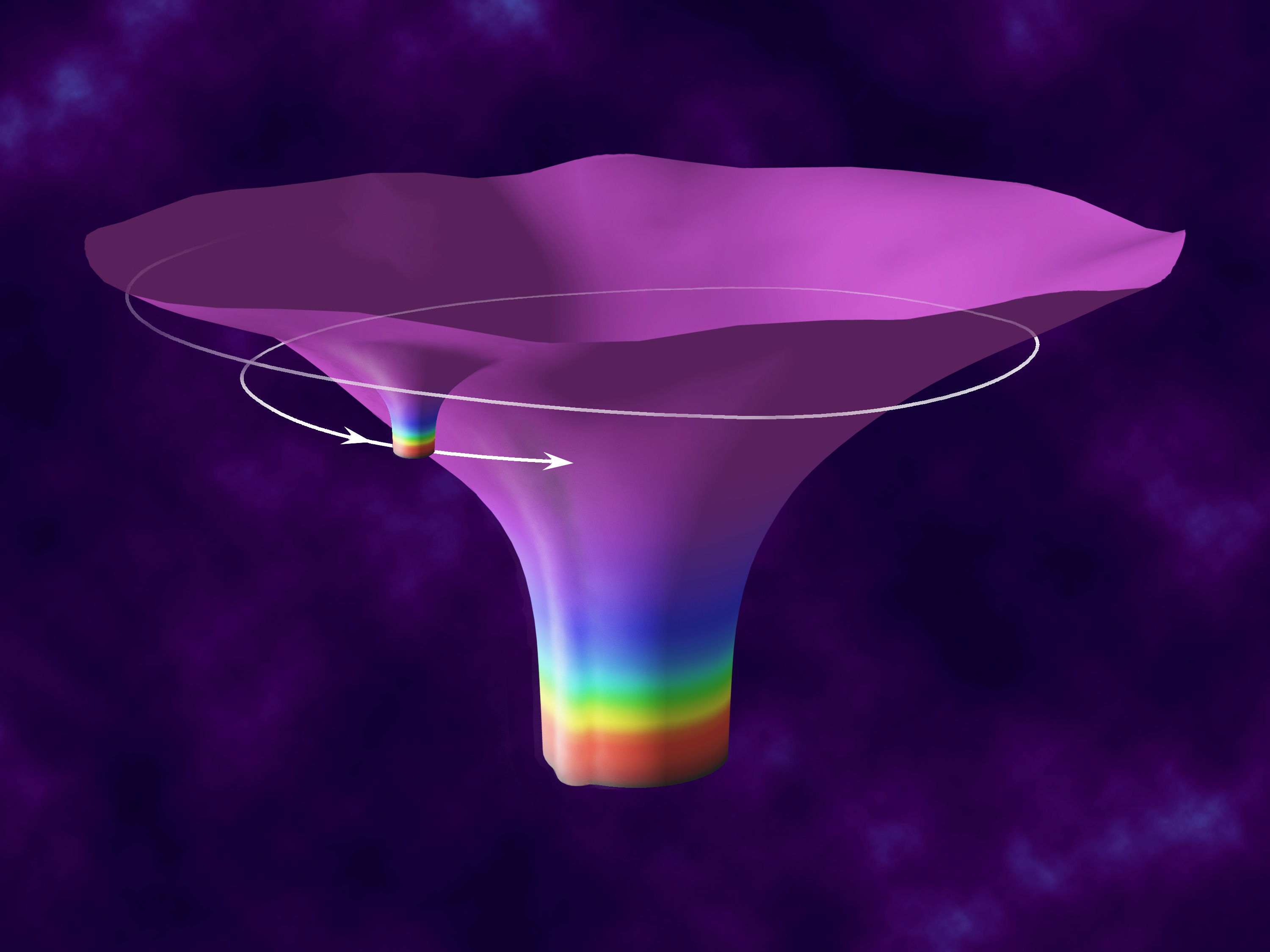
An artist's conception of an infalling body (and it's own potential)
under the influence of the extremely strong gravitational potential of a
black hole is depicted on the left. Such coalescences are responsible
for the gravity waves that are the holy grail of aLIGO and (eventually) LISA.
[Courtesy: LISA/SRL Caltech]
After a brief encounter with stellar stability, the subject matter turns
to general relativity, a necessary prerequisite for our studies of both
neutron stars and black holes. The lectures summarize metrics, the
Equivalence principal, Einstein's field equations, gravitational
redshift, and introduce the Schwarzschild solution for static,
spherically symmetric systems. The lynchpin physical tests of Einstein's
theory are addressed, specifically light deflection and precession of
the perihelia. Exploration of gravitational radiation is deferred to
later in the course, when binary pulsars are discussed.
An artist's conception of an infalling body (and it's own potential)
under the influence of the extremely strong gravitational potential of a
black hole is depicted on the left. Such coalescences are responsible
for the gravity waves that are the holy grail of aLIGO and (eventually) LISA.
[Courtesy: LISA/SRL Caltech]
Prior to our neutron star studies will be the consideration of stellar
rotation. and strong magnetic field development. Oblateness of rapidly
rotating stars will be addressed, specifically Maclaurin spheroids,
which serves both to investigate stability of white dwarfs and neutron
stars, and also as a preparation for gravitational quadrupole radiation
later in the course. The neutron star theme will begin with the
exploration of nuclear/particle physics of their interiors, including
the Baym-Bethe-Pethick equation of state, nucleon-nucleon interactions
and pion condensation. Neutron star models, mass determinations and
their maximum mass will then be examined.
A schematic of neutron star interior structure displaying various zones
and probable/possible constituents [Credit: F. Weber].
 The neutron star studies will then turn our attention to their
observational manifestations, pulsars. Starting with the radio pulsar
discovery and various radio properties, the course will explore pulsar
electrodynamics, their winds, characteristics of the magnetospheric
geometry, and spin-down. The high energy astrophysics of pulsars,
including magnetospheric emission mechanisms and pair cascades, and the
relationship to the radio pulsar death line, will all be addressed.
Simple models of glitch activity will be treated, in particular angular
momentum transfer between the superfluid core and the crust in
starquakes. All along, recent observational highlights will embellish
the pedagogy, including new insights provided by NASA's Fermi
Gamma-ray Space Telescope.
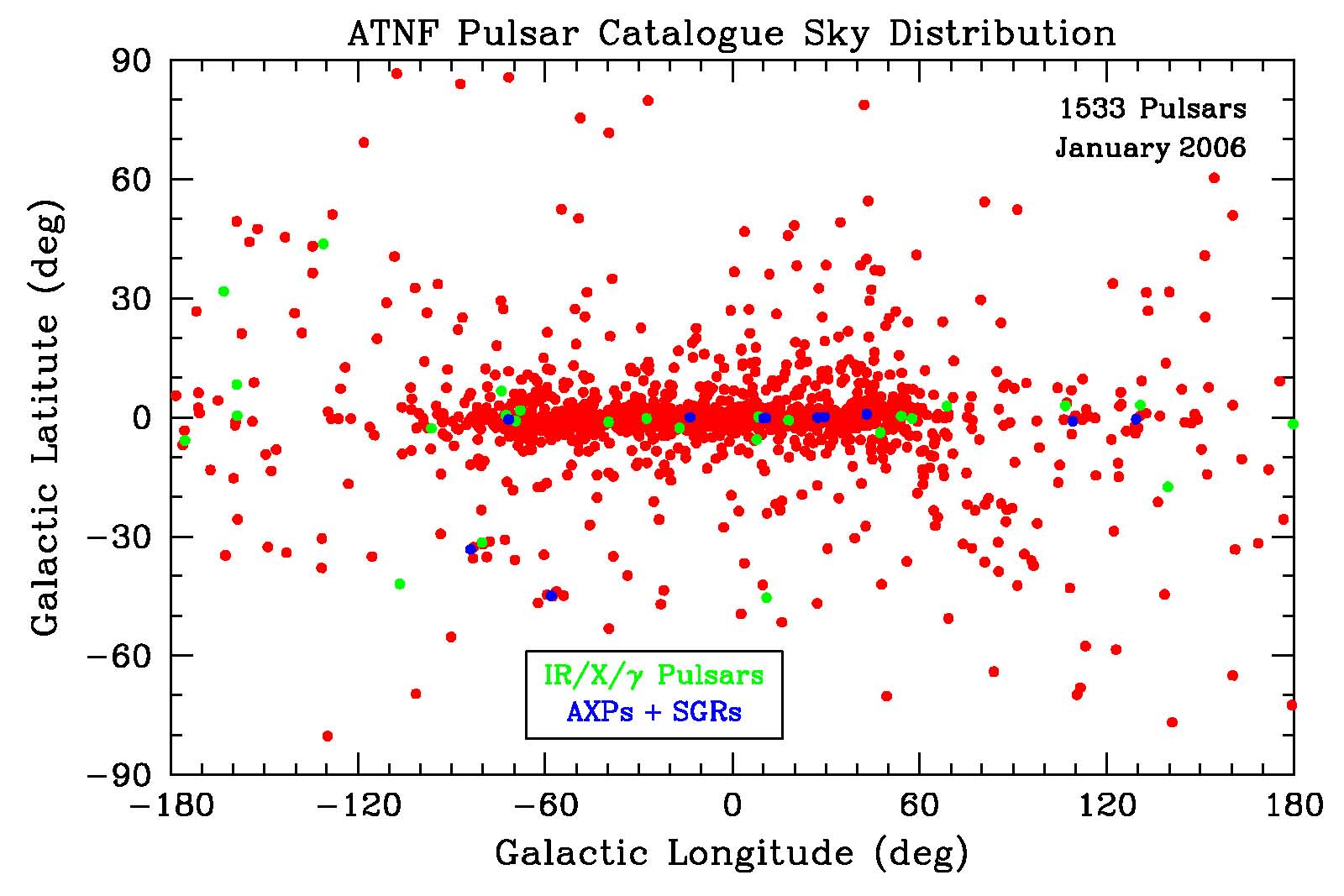
The sky distribution, as of early 2006, for isolated pulsars is
illustrated to the left. This was obtained from the
Australia
Telescope National Facility (ATNF) Pulsar Catalogue.
The neutron star studies will then turn our attention to their
observational manifestations, pulsars. Starting with the radio pulsar
discovery and various radio properties, the course will explore pulsar
electrodynamics, their winds, characteristics of the magnetospheric
geometry, and spin-down. The high energy astrophysics of pulsars,
including magnetospheric emission mechanisms and pair cascades, and the
relationship to the radio pulsar death line, will all be addressed.
Simple models of glitch activity will be treated, in particular angular
momentum transfer between the superfluid core and the crust in
starquakes. All along, recent observational highlights will embellish
the pedagogy, including new insights provided by NASA's Fermi
Gamma-ray Space Telescope.
The sky distribution, as of early 2006, for isolated pulsars is
illustrated to the left. This was obtained from the
Australia
Telescope National Facility (ATNF) Pulsar Catalogue.
 As part of the pulsar material, next is a sub-focus on the topical
magnetars, with their phenomenal power and intense fields; this will
excite our imaginations and blow our minds. Providing the brightest
transients in the galaxy after supernovae, following an observational
overview, our discussion will center on the possible magnetic origin of
their dissipation, their giant flares and associated evidence for
magnetic field restructing. We will also touch upon some of the exotic
QED processes that can be active in the atmospheres and magnetospheres.
Then we will move to an examination neutron star cooling and how surface
emission observations from X-ray telescopes can probe the equations of
state in their interiors, by constraining the mass-radius phase space.
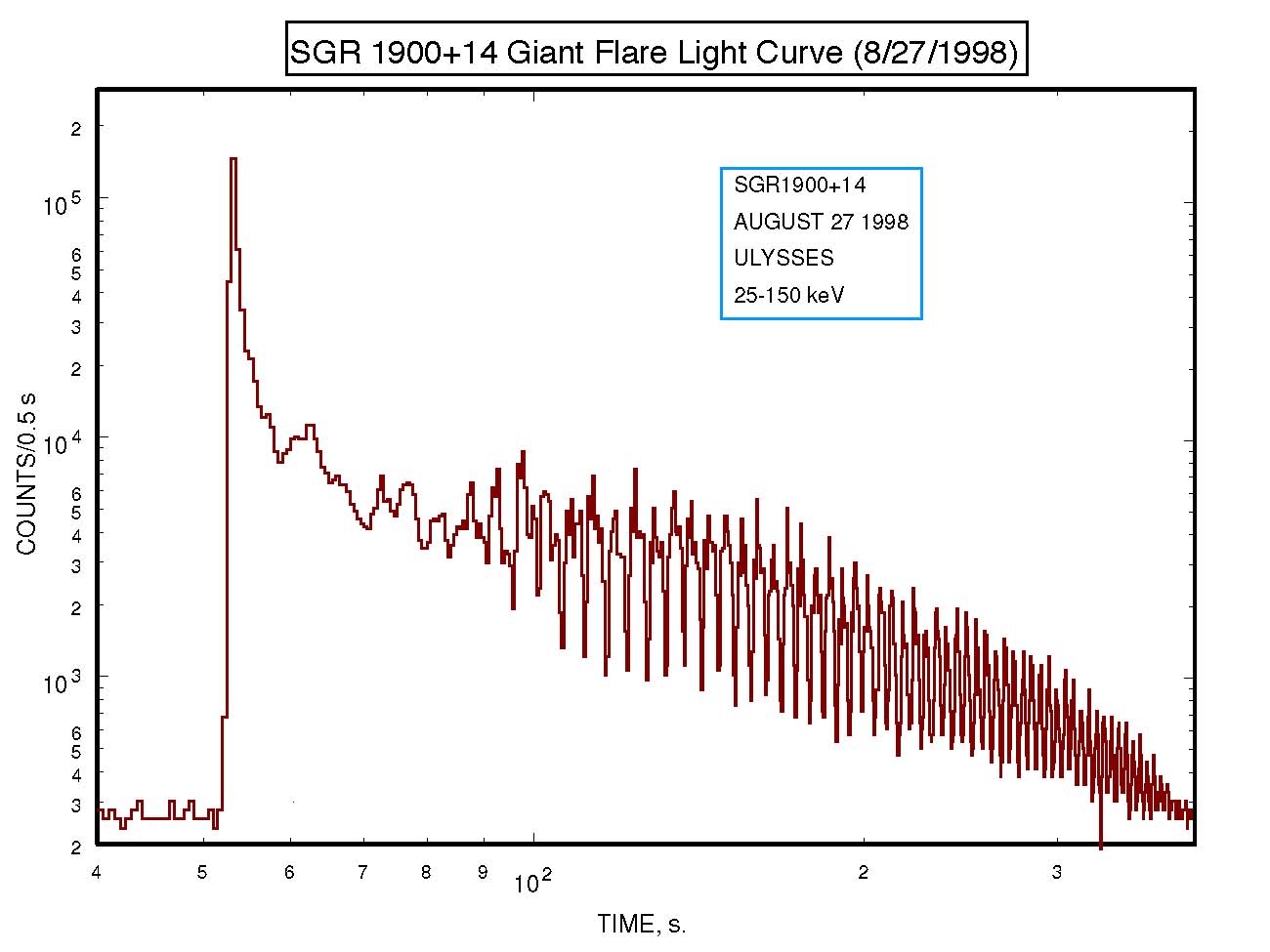
The light curve for the August 1998 giant flare of the soft gamma
repeater SGR1900+14, is depicted to the right, exhibiting the
periodicity that is the hallmark of these powerful outbursts from
magnetars. This data was obtained from the gamma-ray detector on the Ulysses Mission, whose principal
objective was to probe the solar wind. [Courtesy: Kevin Hurley, UC
Berkeley]
As part of the pulsar material, next is a sub-focus on the topical
magnetars, with their phenomenal power and intense fields; this will
excite our imaginations and blow our minds. Providing the brightest
transients in the galaxy after supernovae, following an observational
overview, our discussion will center on the possible magnetic origin of
their dissipation, their giant flares and associated evidence for
magnetic field restructing. We will also touch upon some of the exotic
QED processes that can be active in the atmospheres and magnetospheres.
Then we will move to an examination neutron star cooling and how surface
emission observations from X-ray telescopes can probe the equations of
state in their interiors, by constraining the mass-radius phase space.
The light curve for the August 1998 giant flare of the soft gamma
repeater SGR1900+14, is depicted to the right, exhibiting the
periodicity that is the hallmark of these powerful outbursts from
magnetars. This data was obtained from the gamma-ray detector on the Ulysses Mission, whose principal
objective was to probe the solar wind. [Courtesy: Kevin Hurley, UC
Berkeley]
 Up until this point, we will have been sampling general relativity, but
not "devouring" it. At this juncture, we will explore the properties of
Schwarzschild black holes, focusing on particle motions and photon
orbits in their environs, and the nonsingularity of the event horizon.
Rotating Kerr black holes will be next, including how X-ray line
diagnostics can be used to infer spin-to-mass ratios. The more formal
material of the area theorem and black hole evaporation will also be
briefly addressed. Then we will explore gravitational radiation, its
generation and impact upon rotating systems, and its detection by
current laser interferometer initiatives such as aLIGO and LISA. To
encapsulate the exotic nature of gravity waves, we summarize potential
astrophysical sources, in particular the distant binary black hole mergers
now detected by aLIGO, and Galactic binary pulsar systems, both of which afford
stunningly powerful probes of Einstein's landmark theoretical
predictions.
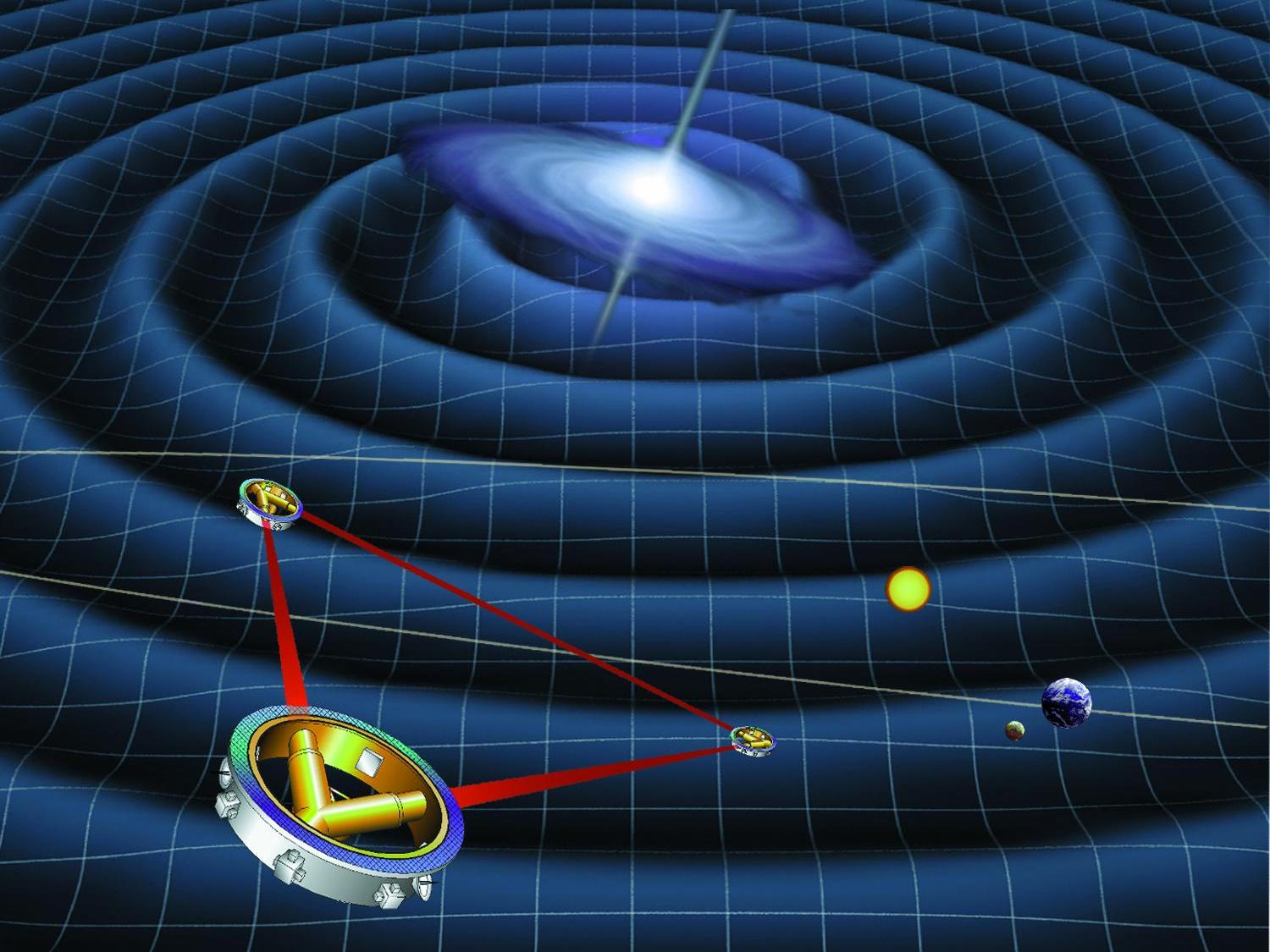
At right is an artist's visualization of gravitational waves from a
black hole together with the planned
Laser Interferometer Space
Antenna (LISA), NASA's space initiative to detect gravitational
radiation from compact objects.
Up until this point, we will have been sampling general relativity, but
not "devouring" it. At this juncture, we will explore the properties of
Schwarzschild black holes, focusing on particle motions and photon
orbits in their environs, and the nonsingularity of the event horizon.
Rotating Kerr black holes will be next, including how X-ray line
diagnostics can be used to infer spin-to-mass ratios. The more formal
material of the area theorem and black hole evaporation will also be
briefly addressed. Then we will explore gravitational radiation, its
generation and impact upon rotating systems, and its detection by
current laser interferometer initiatives such as aLIGO and LISA. To
encapsulate the exotic nature of gravity waves, we summarize potential
astrophysical sources, in particular the distant binary black hole mergers
now detected by aLIGO, and Galactic binary pulsar systems, both of which afford
stunningly powerful probes of Einstein's landmark theoretical
predictions.
At right is an artist's visualization of gravitational waves from a
black hole together with the planned
Laser Interferometer Space
Antenna (LISA), NASA's space initiative to detect gravitational
radiation from compact objects.
 The course now evolves into another "astrophysical manifestation" phase,
focusing first on gamma-ray bursts, the exotic transients that have
captured the imaginations of astrophysicists for over three decades. The
development of their paradigm is followed, from the galactic neutron
star hypothesis to a cosmological population with measured redshifts
that are believed to originate from massive supernovae or coalescence of
binary compact objects. Then we explore X-ray binaries, accreting
systems that emit prominently in X-rays. Key signatures of these
sources that elucidate their environs are cyclotron emission lines,
which probe their fields, and quasi-periodic oscillations that probe the
dynamics of their accretion disks. As an entree into the world of
accreting black holes that expel matter through jets, the course then
summarizes the properties of microquasars, a comparatively recent
addition to the zoo of compact objects, which exhibit superluminal
motion within structured jets.
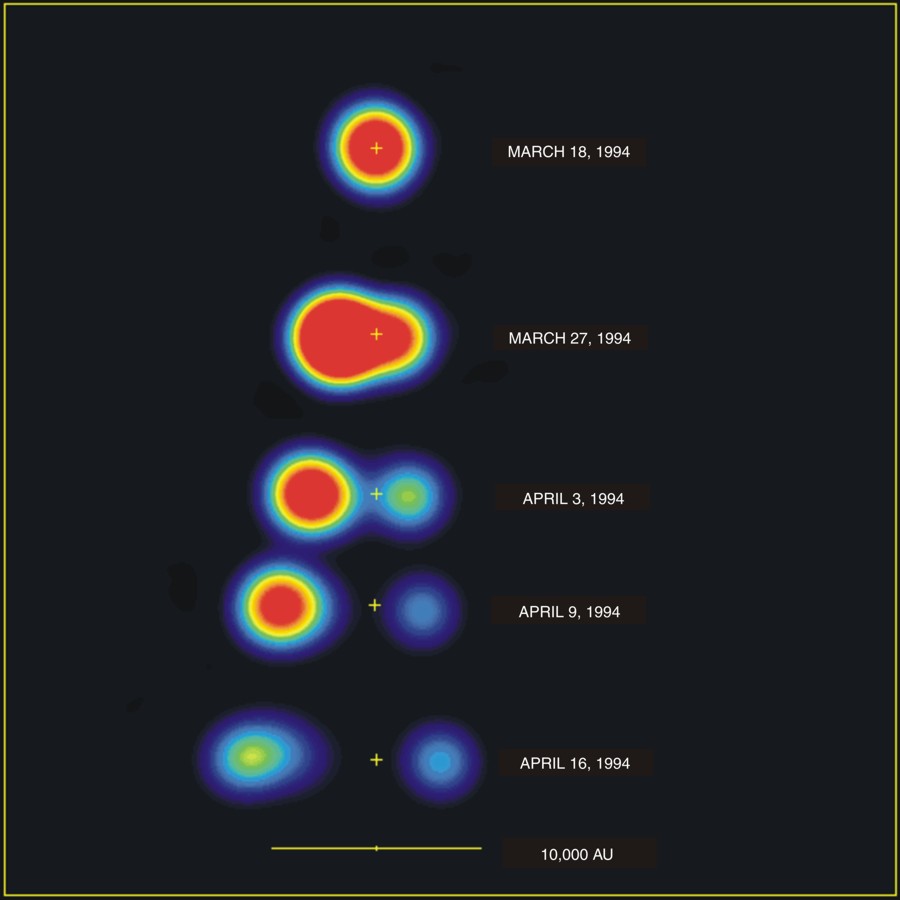
A time sequence of radio images of the galactic microquasar GRS1915+105 is depicted
at left. These images were obtained using the
Very Large Array of radio telescopes,
and illustrates the motion of blobs of luminous material
that are expanding superluminally from a central compact object (black hole).
The course now evolves into another "astrophysical manifestation" phase,
focusing first on gamma-ray bursts, the exotic transients that have
captured the imaginations of astrophysicists for over three decades. The
development of their paradigm is followed, from the galactic neutron
star hypothesis to a cosmological population with measured redshifts
that are believed to originate from massive supernovae or coalescence of
binary compact objects. Then we explore X-ray binaries, accreting
systems that emit prominently in X-rays. Key signatures of these
sources that elucidate their environs are cyclotron emission lines,
which probe their fields, and quasi-periodic oscillations that probe the
dynamics of their accretion disks. As an entree into the world of
accreting black holes that expel matter through jets, the course then
summarizes the properties of microquasars, a comparatively recent
addition to the zoo of compact objects, which exhibit superluminal
motion within structured jets.
A time sequence of radio images of the galactic microquasar GRS1915+105 is depicted
at left. These images were obtained using the
Very Large Array of radio telescopes,
and illustrates the motion of blobs of luminous material
that are expanding superluminally from a central compact object (black hole).
 Our final focal points will be supermassive black holes and elements of
accretion theory pertaining to them. After exploring some of the
observational characteristics of active galactic nuclei, including a
brief outline of Seyferts, blazars and unification scenarios for their
morphology, the material will briefly cover spherical Bondi accretion, angular
momentum characteristics and elements of accretion disk structure.
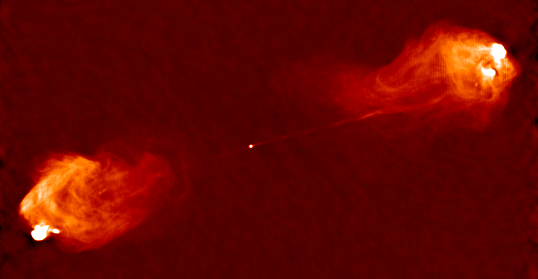
At right is a 6cm radio image (from the
Very Large Array) of the
radio galaxy Cygnus A, displaying both its beautiful asymmetric jets
emanating from a compact nucleus, and its Mpc-scale lobes with prominent
hotspots.
Our final focal points will be supermassive black holes and elements of
accretion theory pertaining to them. After exploring some of the
observational characteristics of active galactic nuclei, including a
brief outline of Seyferts, blazars and unification scenarios for their
morphology, the material will briefly cover spherical Bondi accretion, angular
momentum characteristics and elements of accretion disk structure.
At right is a 6cm radio image (from the
Very Large Array) of the
radio galaxy Cygnus A, displaying both its beautiful asymmetric jets
emanating from a compact nucleus, and its Mpc-scale lobes with prominent
hotspots.