

Home
Studies
& Data Analysis
Methods
Microscope studies
Flagella experiment
Laboratory math
Blood fractionation
Gel electrophoresis
Protein gel analysis
Mitochondria
Concepts/ theory
Keeping a lab notebook
Writing research papers
Dimensions & units
Using figures (graphs)
Examples of graphs
Experimental error
Representing error
Applying statistics
Principles of microscopy
Solutions & dilutions
Protein assays
Spectrophotometry
Fractionation & centrifugation
Radioisotopes and detection


Homeostasis, Steady States, and Equilibria
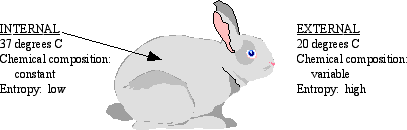
Misuse of the term "equilibrium" is one of the most common mistakes in the biological sciences. Guilty parties include textbook authors, teachers, researchers, and even students. Here is an illustration of the difference between an equilibrium and other situations in which there is constancy.
Homeostasis
A 1981 edition of Webster's dictionary provides a rather narrow definition of the term homeostasis, refering specifically to animals. Homeostasis was defined as the maintenance in an animal of a "constant internal milieu," that is, a relatively constant internal environment, despite changes to the external environment. More generally, homeostasis can refer to the maintenance of relatively constant conditions within any system. In fact the term is now used in reference to cells, animals, plants, and local or global ecosystems. The term could probably apply to a self-sufficient machine, for that matter. A key concept is that mechanisms must be in place to maintain constancy within a system, and that the system is itself dynamic. The latter quality is essential to the definition. The living tissue in a tree maintains homeostasis, but not so a block of wood after it is cut from the tree.
Steady state (dynamic equilibrum)
You may also have heard the phrase steady state. An organism an be said to be in a steady state, in which case we are using the phrase interchangeably with the term homeostasis. Why not take advantage of the opportunity to be more precise, though?. While homeostasis refers to the entire internal environment, the term steady state can be restricted to describing specific mechanisms. A cell is in homeostasis because every mechanism that keeps it alive is in a steady state. For example, an enzyme complex called sodium/potassium ATPase (also known as the sodium/potassium pump) uses energy from the hydrolysis of ATP to "trade" sodium ions for potassium ions, thus maintaining a constant internal concentration of potassium. Potassium concentration can be said to be in a steady state. The term dynamic equilibrium is also used synonymously with steady state, but the use of that term can be confusing. A dynamic equilibrium is not the same as a chemical equilibrium.
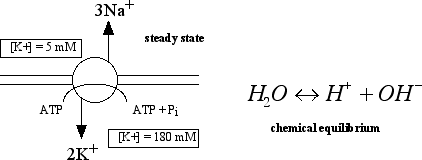
Chemical equilibrium
A beaker of distilled water contains water molecules and it's ion products in a chemical equilibrium. Without putting energy into the system it stays just as it is. Change the system, such as by tossing in some hydrochloric acid, and the balance changes. However, within a short time complete ionization of the HCl takes place and you again have a chemical equilibrium (with higher concentration of hydrogen ions, a.k.a. lower pH). The key concept is that any system is most stable at its lowest free energy state under current conditions. When that state is reached the system is at equilibrium. In a steady state, energy is put into the system constantly in order to maintain a higher free energy state than at equilibrium.
Summary
Features of a steady state:
- Conditions are stable within the system
- Free energy is continuously put into the system
- Over time, the system is maintained in a higher state of order than its surroundings
Features of an equilibrium:
- Conditions are stable within the system
- Net free energy neither enters nor escapes the system
- Over time, any difference in entropy (state of disorder) between the system and the external environment tends to disappear

Visitors: to ensure that your message is not mistaken for SPAM, please include the acronym "Bios211" in the subject line of e-mail communications
Created by David R. Caprette (caprette@rice.edu), Rice University Dates