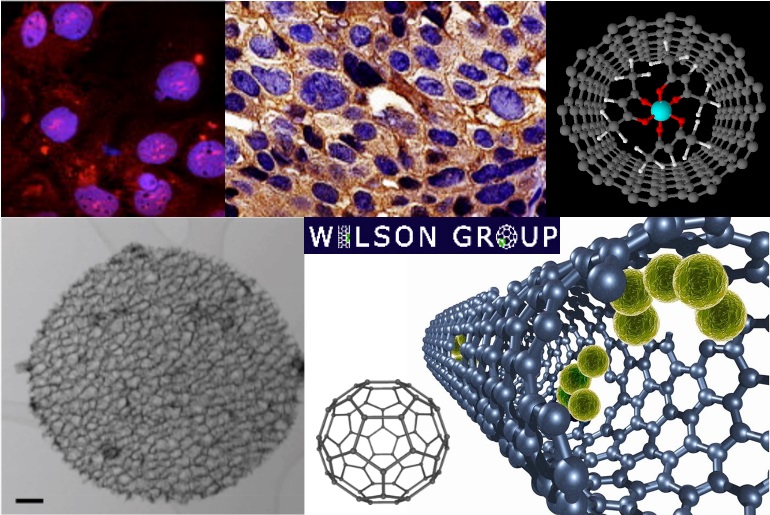
The Wilson Research Group program involves bringing carbon nanotechnology to the
fields of biology and medicine. The nanoparticle "building blocks" of this program
are fullerenes (C60), endohedral metallofullerenes (M@C60), and ultra-short (20 nm
long) single-walled carbon nanotube capsules (US-tubes). Externally, these carbon
nanostructures are being chemically derivatized to make them biocompatible and cell-specific
through peptide and antibody targeting. Internally, the nanostructures are being
loaded with materials of medical interest for diagnostic and therapeutic medicine.
Materials of interest include Fe2O3 and Gd3+ for magnetic resonance imaging (MRI),
I2 molecules for X-ray computed tomography (CT) imaging and alpha-particle radionuclides
(Ac-225 and At-211) for alpha-autoimmune of single-cell cancers. Cancer therapies
are also being developed that take advantage of superparamagnetic nanostructures,
such as Gd3+@US-tubes, that are simultaneously diagnostic (MRI-guided) and therapeutic
(magnetic hyperthermia) agents in a single package. All these carbon nanostructures,
with their medical cargos, are designed to be among the first intracellular agents,
since the future of medicine will involve the early detection of disease at the cellular
level when it is most treatable. Nanoengineered materials promise great advances
in medicine, and, working with colleagues at various medical centers, our goal is
to bring key, high-performance materials to the clinic as soon as possible.
October 30, 2009.
Meghan Jebb joins the group
as a new graduate student. Welcome!
October 23, 2009.
Stuart Corr returns as a
visiting student. Welcome back!
September 30, 2009.
Scott Berger passes his
Masters thesis defense. Congratulations!
August 28, 2009. Ari Berlin joins the lab as an undergraduate research assistant.
Welcome!
August 12, 2009. Ivana Peralta passes her Ph.D. thesis defense. Congratulations!
August 5, 2009. After nearly 7 years, the website has finally been updated!