Syllabus

Schedule

Resources

Fundamentals of Experimental Biology – Course syllabus

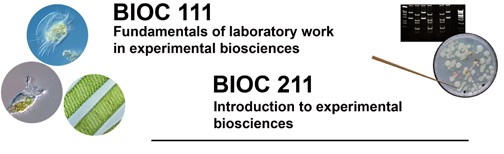
Bios 111 is a laboratory course that introduces fundamental methods and standard practices in biosciences laboratories.  One of our major objectives is to prepare students who have limited laboratory experience to move on to courses that require more independent learning, including Bios 211, the intermediate level course for biosciences majors. Students successfully completing the course should also be ready for independent study work (Bios 310) in Biochemistry & Cell Biology laboratories.

***Registration requires instructor permission***

Registration is closed on ESTHER. This does not mean that the course itself is closed. For information, go to the Bios 111/211 sign-up page. If you must sign up from off campus then please contact an instructor for an alternative URL.

http://www.ruf.rice.edu/~bioslabs/bios211/rice_only/211signup.html

The "fundamentals" covered in BIOS 111 include preparing/diluting solutions, using automatic pipettors, conducting a colorimetric assay, spectrophotometry, basic light microscopy, laboratory record keeping, data collection and analysis. Projects will include a three week introduction to DNA work, including a plasmid DNA "mini-prep," restriction enzyme digests,agarose gel electrophoresis and transformation.

Overview of studies

  • Week 1 Laboratory safety; introduction to recordkeeping; introduction to pipetting, solutions, dilutions, colorimetric assays, and spectrophotometry
  • Week 2 Plasmid DNA mini prep; restriction enzyme digests of plasmid DNA (single digest); agarose gel electrophoresis of digest reactions; DNA migration and standard curve; gel purification to remove restriction enzymes); pouring LB plates with antibiotic for later selection of transformed colonies
  • Week 3 DNA ligation; bacterial transformation (chemical/heat shock method); streak LB-antibiotic plates to obtain single colonies of transformed bacteria
  • Week 4 Plasmid DNA mini preps of transformants; restriction enzyme digests of plasmid DNA (single and double digests); pour agarose gels and conduct electrophoresis of digest reactions; produce DNA standard curve, determine DNA quantity by staining intensity; calculate efficiency of transformation (EOT)
  • Week 5 Introduction to light microscopy; preparing wet mounts; strategy for finding specimens, obtaining resolution and contrast; dark field and phase contrast optics; demonstration of harvesting Naegleria gruberi cells from agar plates; examine Naegleria cultures; practice microscopic examination of additional living specimens; conduct measurements with a light microscope
  • Week 6 Experiments with Naegleria gruberi transformation; harvest cells from plates, wash, estimate cell concentrations with a counting chamber; dilute and prepare treated cultures, examine for % transformation

Evaluation of performance

We expect students to follow explicit instructions and to recall and apply previous training to each new project. Puncutality, safe conduct in the laboratory, and efficient completion of responsibilities will enter into the evaluation of overall performance. Each student will keep a laboratory notebook, turning in duplicate pages each week for spot checks. Some laboratory sessions will be followed and/or preceded by homework assignments to be submited in class. Methodology used in the DNA work will be written up as a materials and methods section of a journal article. This will be the only formal written assignment. A first draft will be submitted prior to completion of the DNA work, comments returned, and a final version submitted at the end of the course.

Course grade determination

Laboratory performance 25%
Laboratory notebook 25%
Homework and pre-laboratory assignments 25%
Materials/methods drafts and final paper 25%

      For full credit, all assignments must be submitted on time.  The penalty for late assignments is 10% of the total score per day late, including weekends and holidays.

When and where

The course will be offered the first and second halves of the fall semester and the first half of the spring semester.  Six meetings will be held from 2 to 5 pm in the Biology Building basement or in Biology 141.  A holiday break for either Labor Day or MLK Day will interrupt each first half semester course, and a break for the Thanksgiving holiday will interrupt the second half semester course.

Semester Days
Fall, first half M, F
Fall, second half M, W, F
Spring, first half F

Resources

  • Course web pages
  • Graphing tutorial (on line)
  • Printed course syllabus
  • "Biosciences laboratory survival manual"
  • Weekly handouts (guides to laboratory responsibilities and homework assignments)


Copyright and Intended Use
Visitors: to ensure that your message is not mistaken for SPAM, please include the acronym "Bios211" in the subject line of e-mail communications
Created by David R. Caprette (caprette@rice.edu), Rice University March 26, 2008
Updated 21 Jul 08